
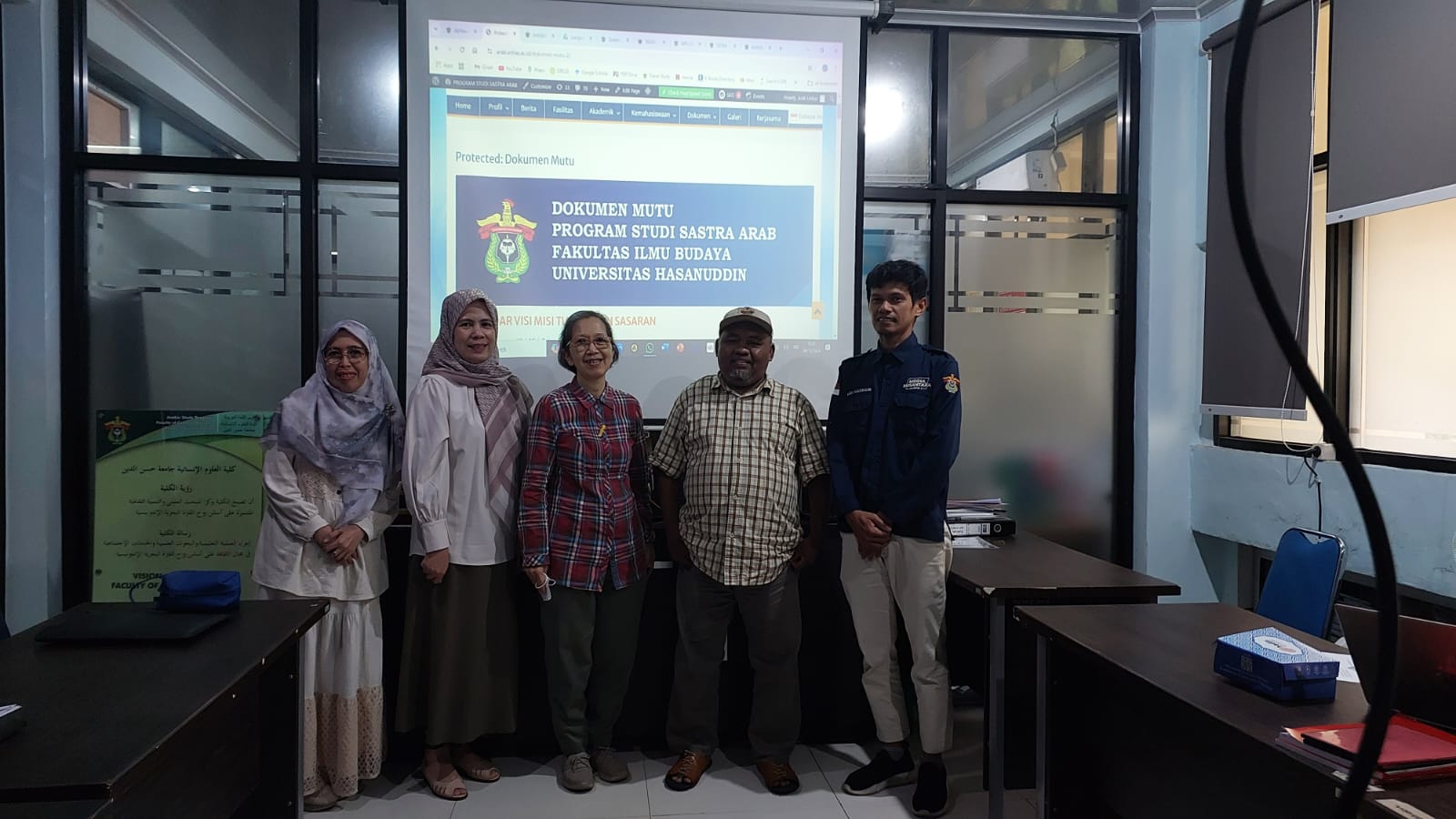
The Arabic Literature Study Program was audited by the LPMPP Quality Auditor
On Wednesday, December 4, 2024, at 2:30 PM, at the Arabic Literature Lecturer Meeting Room, Faculty of Cultural Sciences, Hasanuddin University (Unhas), an Internal Quality Audit was carried out which is very important for the development and improvement of the quality of education in the Arabic Literature Study Program. This activity was initiated by the Institute for Quality Assurance and Educational Development (LPMPP) Unhas, which sent two competent auditors, namely Dra. Ria Rosdiana Jubhari, MA, Ph.D., and Dr. Marwah, SH, MH. Both auditors have academic backgrounds and experience in the field of quality assurance, so they are expected to provide constructive input for the study program.
The audit began with remarks from the Head of the Arabic Literature Study Program, Haeruddin, SS, MA. In his remarks, he emphasized the importance of accreditation in enhancing the credibility and competitiveness of the Arabic Literature Study Program. He stated that the Study Program has successfully achieved Superior accreditation from the National Accreditation Board for Higher Education (BAN-PT), which is the highest recognition in the higher education system in Indonesia. Furthermore, certification from the ASEAN University Network-Quality Assurance (AUN-QA) demonstrates that the study program not only meets national standards but also meets international standards. This is clear evidence of the Arabic Literature Study Program's commitment to providing high-quality education that is relevant to the needs of the times.
The presence of Haeriyyah, S.Ag., M.Ag., Secretary of the Department of West Asian Literature, and Dr. Andi Agussalim, M.Hum., Head of the Language Learning Technology Development Laboratory, also provided support for the audit. The presence of these stakeholders demonstrates that internal quality audits are not solely the responsibility of auditors and study programs, but also involve all elements within the faculty. This is crucial because support from various parties will strengthen the audit process and the implementation of the resulting recommendations.
In its implementation, the audit team assessed all standards fulfilled by the Arabic Literature Study Program through the Internal Quality Assurance System (SPMI) application accessible at https://spmi.unhas.ac.id/. This audit process involved examining important documents related to educational quality, including the curriculum, learning process, research, and community service. Although it was found that the documents uploaded in the application were incomplete, the two auditors still expressed their appreciation for the Arabic Literature Study Program's readiness in providing quality documents that can be accessed through the study program's official website at arab.unhas.ac.id. This demonstrates that the study program has put in considerable effort in preparing for the audit and is committed to continuously improving the quality of education provided.
This internal quality audit is not merely a formal activity, but an opportunity for the Arabic Literature Study Program to reflect on and evaluate its ongoing educational process. With input from the auditors, the study program can identify existing strengths and weaknesses and formulate appropriate corrective measures. For example, if the audit reveals that the existing curriculum needs updating to be more relevant to developments in science and technology, the study program can immediately take action to revise the curriculum.
Furthermore, internal quality audits also serve as a tool to increase accountability and transparency in study program management. With a clear and documented system, all parties, including students, lecturers, and the public, can see and understand how the educational process is conducted. This is crucial for building public trust in higher education institutions, especially in today's information age, where access to information is readily available.
In closing, the Internal Quality Audit conducted by the Arabic Literature Study Program, Faculty of Humanities, Hasanuddin University, represents a strategic step in improving the quality of education. With support from various parties and a strong commitment from all elements of the study program, it is hoped that the results of this audit will serve as a foundation for continuous improvement. Through this process, the Arabic Literature Study Program not only strives to maintain its accreditation but also aspires to continue innovating and contributing to the development of science and culture, as well as meeting the public's expectations for quality education.