Hasanuddin University Expert Presents Research on Low-Carbon Healthcare Services at CECE 2026 in Sydney
Makassar, 23-25 September 2026
Hasanuddin University (UNHAS) participated in the International Conference on Circular Economy for Climate and Environment (CECE 2026), held in Sydney, Australia, from 23-25 September 2026, contributing research on policy pathways for circular and low-carbon healthcare in Indonesia.
Held at the Aerial Function Centre in Sydney, CECE 2026 brought together researchers, policymakers, industry representatives, and practitioners from different countries to discuss approaches to climate change mitigation and the transition toward a circular economy. The conference featured plenary sessions, keynote lectures, panel discussions, and scientific presentations covering circular economy policies, sustainable energy, healthcare, mining, plastics, water, and environmental management.
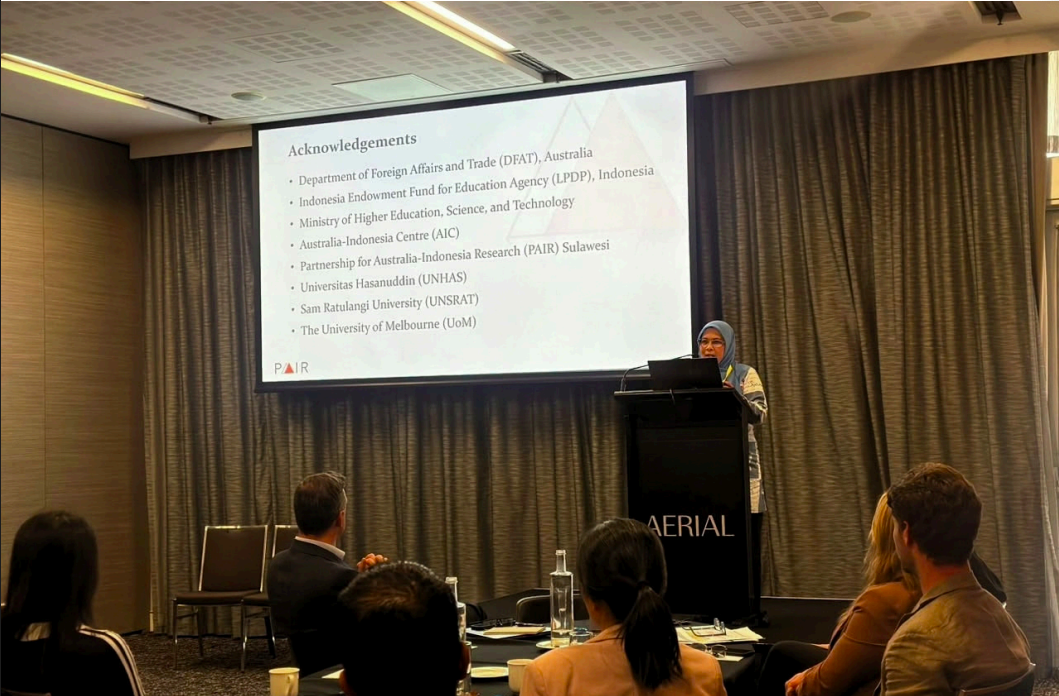
Representing UNHAS, Prof. Sri Astuti Thamrin from the Master's Program in Data Science, Faculty of Mathematics and Natural Sciences, delivered an oral presentation titled “Policy and Regulatory Pathways for Circular and Low-Carbon Healthcare in Indonesia” during the Circular Policies session.
Her presentation examined how circular economy principles and low-carbon strategies could be integrated into Indonesia's healthcare sector. The research was conducted as part of the PAIR Sulawesi Net Zero 2.4 project: Financial and Economic Modelling, which is supported by funding from the Ministry of Higher Education, Science, and Technology of the Republic of Indonesia (Kemendiktisaintek) through the Indonesia Endowment Fund for Education (LPDP) and the Australian Department of Foreign Affairs and Trade (DFAT).
The study involved researchers from UNHAS, the University of Melbourne, Sam Ratulangi University, Universitas Ichsan Gorontalo, and Khairun University. It examined policy frameworks, financing mechanisms, and implementation challenges related to healthcare decarbonization in Indonesia.
The research found that while Indonesia has broader policies supporting energy transition and sustainability, specific pathways for healthcare facilities remain limited. The study highlighted several areas requiring further attention, including stronger policy integration, innovative financing mechanisms, improved data systems, and sustainable procurement practices to support the transition toward circular and low-carbon healthcare services.
Prof. Sri's participation in CECE 2026 provided an opportunity to bring research on Indonesia's healthcare decarbonization into an international discussion on climate and circular economy policies. It also enabled knowledge exchange with researchers and practitioners working on sustainability challenges across different sectors and national contexts.
Through its contribution to CECE 2026, UNHAS continues to expand its international research engagement on climate change and sustainability while strengthening interdisciplinary connections with Indonesian and international research partners. The collaboration also demonstrates the role of evidence-based research in informing policies and practical approaches toward more sustainable and climate-resilient systems.