
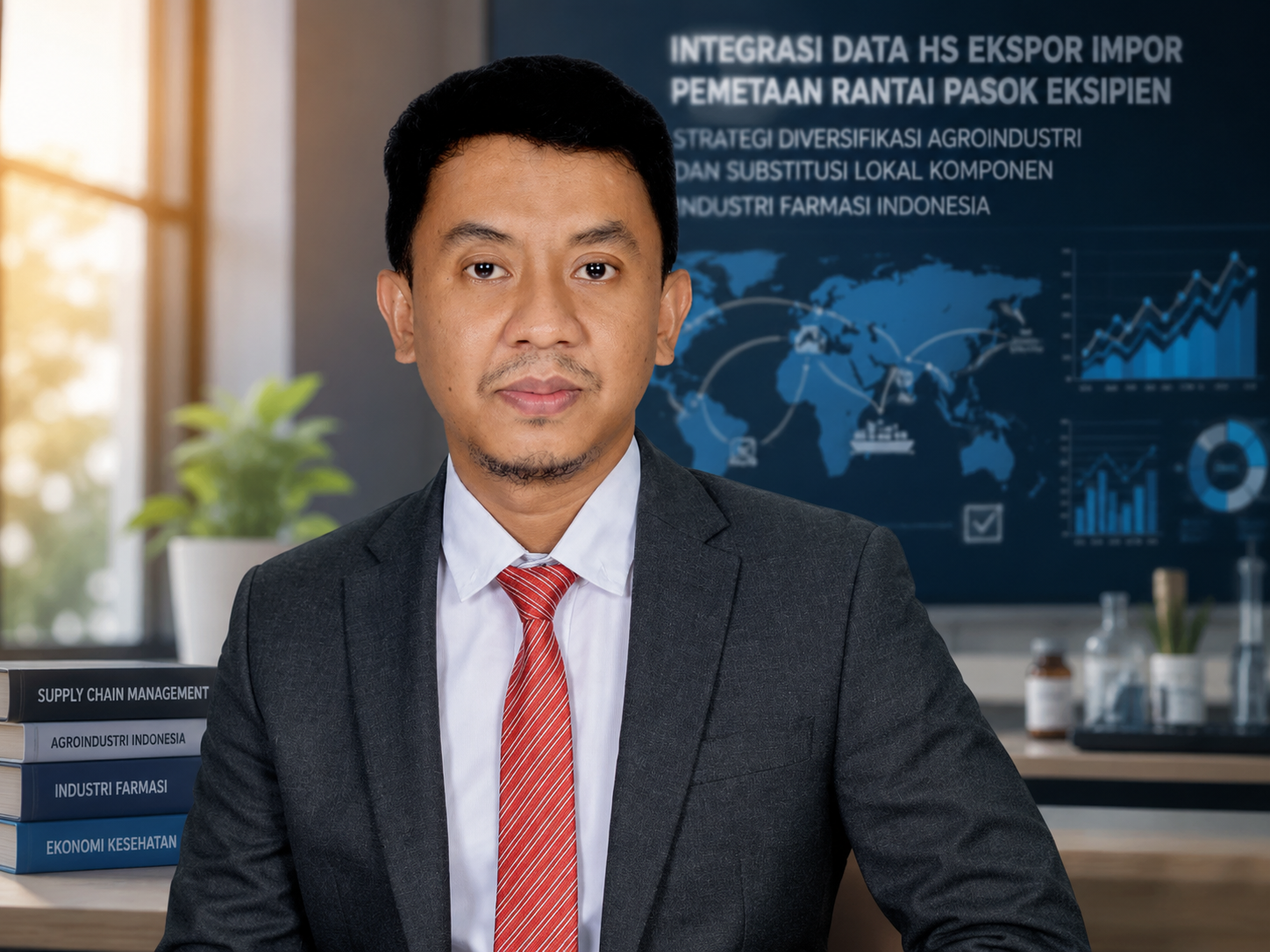
Food Agribusiness Vocational Program Lecturer at Hasanuddin University Secures 2026 PDPU BIMA Research Grant
Indonesia’s Pharmaceutical Industry Dependence Through Trade Data Analysis
Indonesia’s pharmaceutical industry continues to face a significant challenge in reducing its dependence on imported raw materials, particularly in achieving a more resilient and self-reliant national healthcare industry. Amid global supply chain disruptions and fluctuations in international trade, this issue has become increasingly relevant—not only for industrial stakeholders but also for the academic community.
Responding to this challenge, Zulfikar Syamsi, a lecturer in the Food Agribusiness Study Program at the Vocational Faculty of Hasanuddin University, has successfully secured funding under the 2026 Beginner Lecturer Research Program (PDPU) BIMA through a research proposal entitled, “Integration of Export–Import HS Data in Mapping Excipient Supply Chains: Agroindustrial Diversification Strategies and Local Substitution of Components in Indonesia’s Pharmaceutical Industry.”
The research focuses on mapping the supply chain of pharmaceutical excipients in Indonesia through the integration of Harmonized System (HS)-based trade data and logistics pathway analysis. Excipients are non-active components in pharmaceutical products that play essential roles in maintaining product stability, safety, and quality.
Using a data-driven supply chain analysis approach, the study will utilize official trade data obtained from Statistics Indonesia (BPS), UN Comtrade, and the World Integrated Trade Solution (WITS). The analysis aims to identify import patterns, trade trends, and the structure of Indonesia’s pharmaceutical excipient suppliers.
Beyond supply chain mapping, the research also seeks to explore opportunities for local substitution through agroindustrial development. The potential of domestic raw materials will be assessed by considering technical feasibility, industrial readiness, and the economic value-added that could be generated.
The project is conducted collaboratively by an interdisciplinary research team from Hasanuddin University, consisting of Igods Gabryaldo, A. Anggraini, and Anshar Saud, with the involvement of Food Agribusiness student Achmad Fachriansyah.
The expected outcomes of the study include a comprehensive national excipient supply chain map, identification of components with high potential for local substitution, and strategic recommendations for agroindustry-based diversification of pharmaceutical raw materials.
Furthermore, the research is expected to contribute to evidence-based policymaking while strengthening the synergy between the agroindustrial and pharmaceutical sectors in enhancing supply resilience and promoting the long-term independence of Indonesia’s pharmaceutical industry.
The successful acquisition of the PDPU BIMA 2026 grant also reflects how vocational research initiatives are increasingly aligned with industrial demands and pressing national challenges—demonstrating that trade data analysis is not merely about interpreting numbers, but about building a more independent and sustainable industrial system for the future.