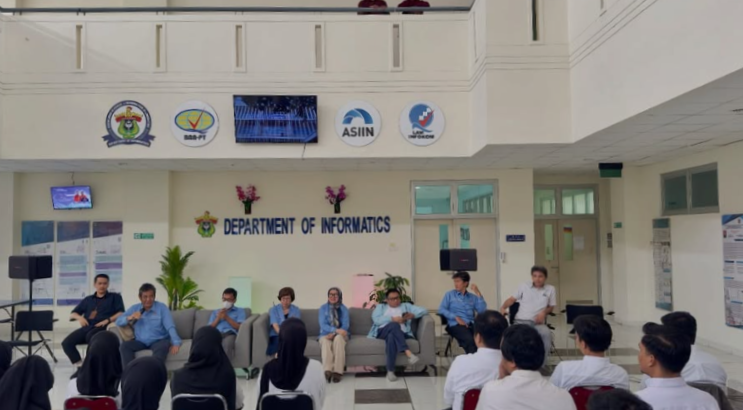
The proposal to establish the Master's Program in Informatics Engineering at Hasanuddin University (PS2TIF) is based on the following considerations:
Departmental Restructuring: The organizational status of the Informatics Engineering Study Program has transitioned from a study program under the Department of Electrical Engineering to an independent Department of Informatics Engineering.
High Demand and Capacity Expansion: Since the launch of the Master's Program in Electrical Engineering in 2004, Informatics Engineering has existed as a concentration alongside Telecommunications Engineering, Energy Engineering, and Control & Computer Engineering. Due to fixed capacity limits, the Master's Program in Electrical Engineering could only admit a limited number of applicants for the Informatics Engineering concentration.
Upgrading the Informatics Engineering concentration into an independent Master's program will yield positive outcomes for both programs. With a high volume of applicants annually, the new Master's Program in Informatics Engineering can accommodate a larger student intake compared to its time as a concentration. Likewise, the Master's Program in Electrical Engineering will be able to admit more students into Telecommunications, Energy, and Control & Computer Engineering, which previously faced stiff competition from the Informatics concentration.
Evolution of the Discipline: The field of Informatics Engineering is no longer restricted to or solely intertwined with Electrical Engineering. It has evolved into a distinct domain encompassing fields such as Computing Everywhere, The Internet of Things, 3D Printing, Advanced, Pervasive and Invisible Analytics, Context-Rich Systems, Smart Machines, Cloud/Client Computing, Software-Defined Applications and Infrastructure, Web-Scale IT, and Risk-Based Security and Self-Protection.
One of the main objectives of establishing the Master's Program in Informatics Engineering is to keep pace with these scientific advancements, thereby producing Master's graduates with high competencies in Informatics Engineering. A similar path was taken by Universitas Gadjah Mada in 2016 when it launched the Master's Program in Information Technology, which originally started as a concentration under the Master's Program in Electrical and Information Technology Engineering.
Sustainability and Growth Potential: The future sustainability and expansion prospects for the Master's Program in Informatics Engineering are exceptionally strong, driven by the high volume of applicants historically seen in the Master's concentration under Electrical Engineering, as well as the strong demand for the Bachelor's (S1) Program in Informatics Engineering at Unhas.
Ketik minimal 2 karakter lalu tekan Enter