
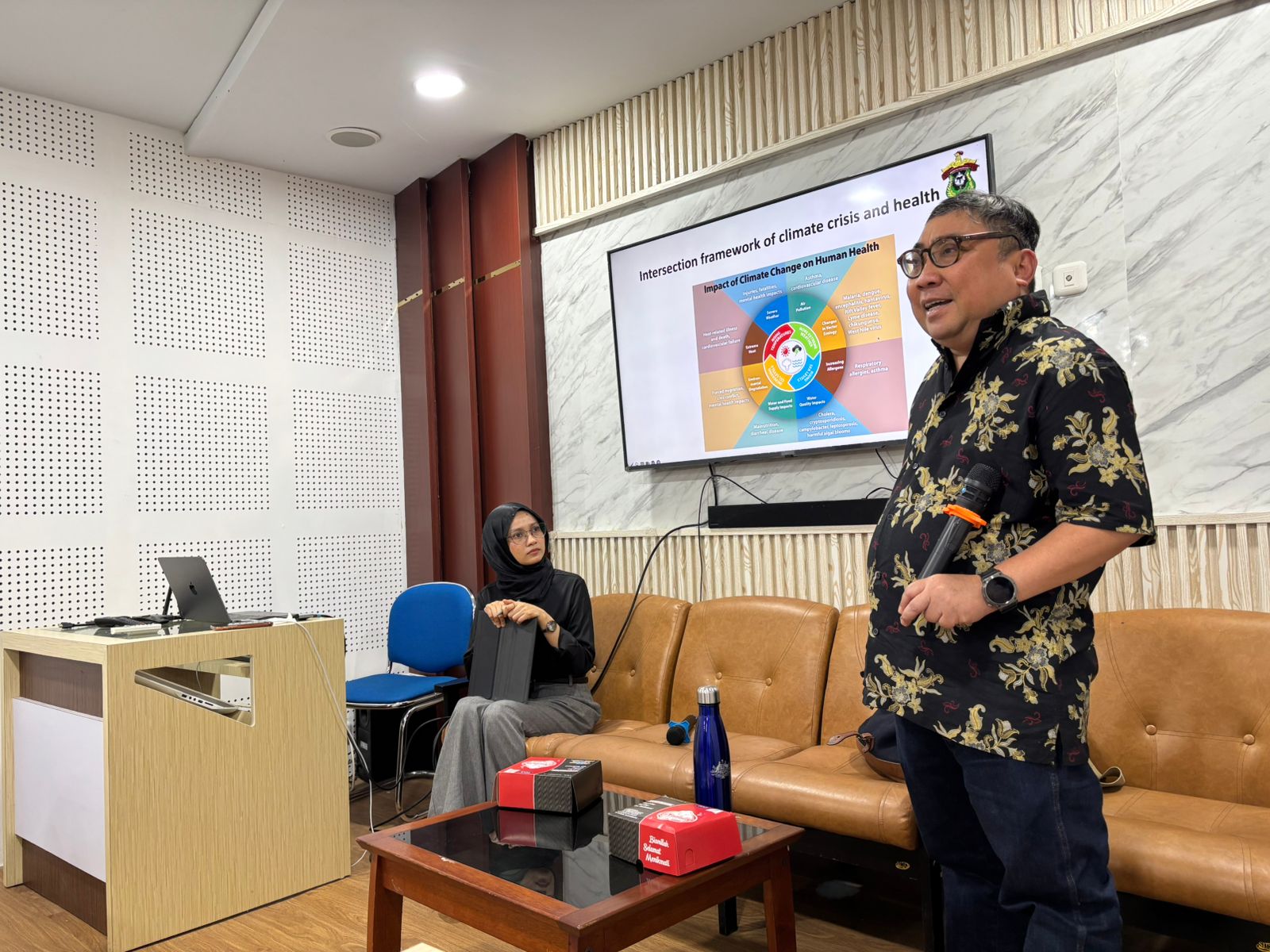
POLiGOV Lab Governance Series Discusses Governance Challenges in the Climate and Health Crisis in the Wallacea Region
Makassar — The Department of Administrative Sciences, Faculty of Social and Political Sciences (FISIP) at Hasanuddin University, through the Policy and Governance Laboratory (POLiGOV Lab), once again held its regular Governance Series event with the theme "Governance Challenges in Addressing Climate-Induced Health and Social Vulnerabilities in the Wallacea Region."
The discussion was moderated by Sri Nurindah Sari Arsyad, S.Sos., M.AP., a research assistant at the POLiGOV Lab, FISIP Unhas. The keynote speaker was Sudirman Nasir, Ph.D., Lecturer at the Faculty of Public Health, Hasanuddin University, and Chair of the Hasanuddin University Climate Crisis and Health Research Group, who emphasized that the climate crisis is a highly complex global challenge that cannot be solved with a single approach.
"The climate crisis is a complex problem that we face together. Therefore, it requires complex solutions and teams, involving various disciplines to find joint solutions," he said. In his presentation, Dr. Sudirman highlighted the importance of intersectional approaches such as the syndemic approach to understand the interrelationships between health, economic, and environmental crises that exacerbate each other.
He also emphasized that the climate crisis must be understood as a social justice issue because its impact is uneven and often exacerbates existing inequalities. Dr. Sudirman, who is also a Senior Fellow at the Australia-Indonesia Center (AIC) and a Visiting Fellow at the Crawford School of Public Policy, Australian National University (ANU), Australia, in early 2025. His involvement in international research and networks enriches the discussion on how public governance approaches can play a role in mitigating the impact of the climate crisis on health and social resilience.
During the discussion session, Andi Ahmad Yani, M.Si., M.Sc., M.PA., a lecturer in the Department of Administrative Science, acted as a discussant, providing insights from a governance perspective. He highlighted the weak quality of the bureaucracy in responding to climate issues and the lack of scientist involvement in the policy-making process. "We need to review how our bureaucracy works. There are no serious efforts to solve existing problems. The state tends to be anti-science, and scientists are only involved in policy implementation, not in the design and decision-making processes," he said.
The discussion also noted an increase in public awareness of issues related to disasters, politics, health, and social issues. This awareness is considered important social capital in promoting more inclusive and evidence-based policy changes. The Governance Series is a regular discussion forum initiated by the POLiGOV Lab of the Department of Administrative Sciences, Faculty of Social and Political Sciences, Hasanuddin University, as a platform for cross-disciplinary exchange of ideas related to public governance and contemporary policies.
The event was attended by Department Chair Prof. Dr. Alwi, faculty members, and students from various departments within FISIP Unhas. Through such activities, POLiGOV Lab is committed to strengthening the role of academics in bridging knowledge, policy, and governance practices to address global challenges such as the climate crisis and social inequality.