
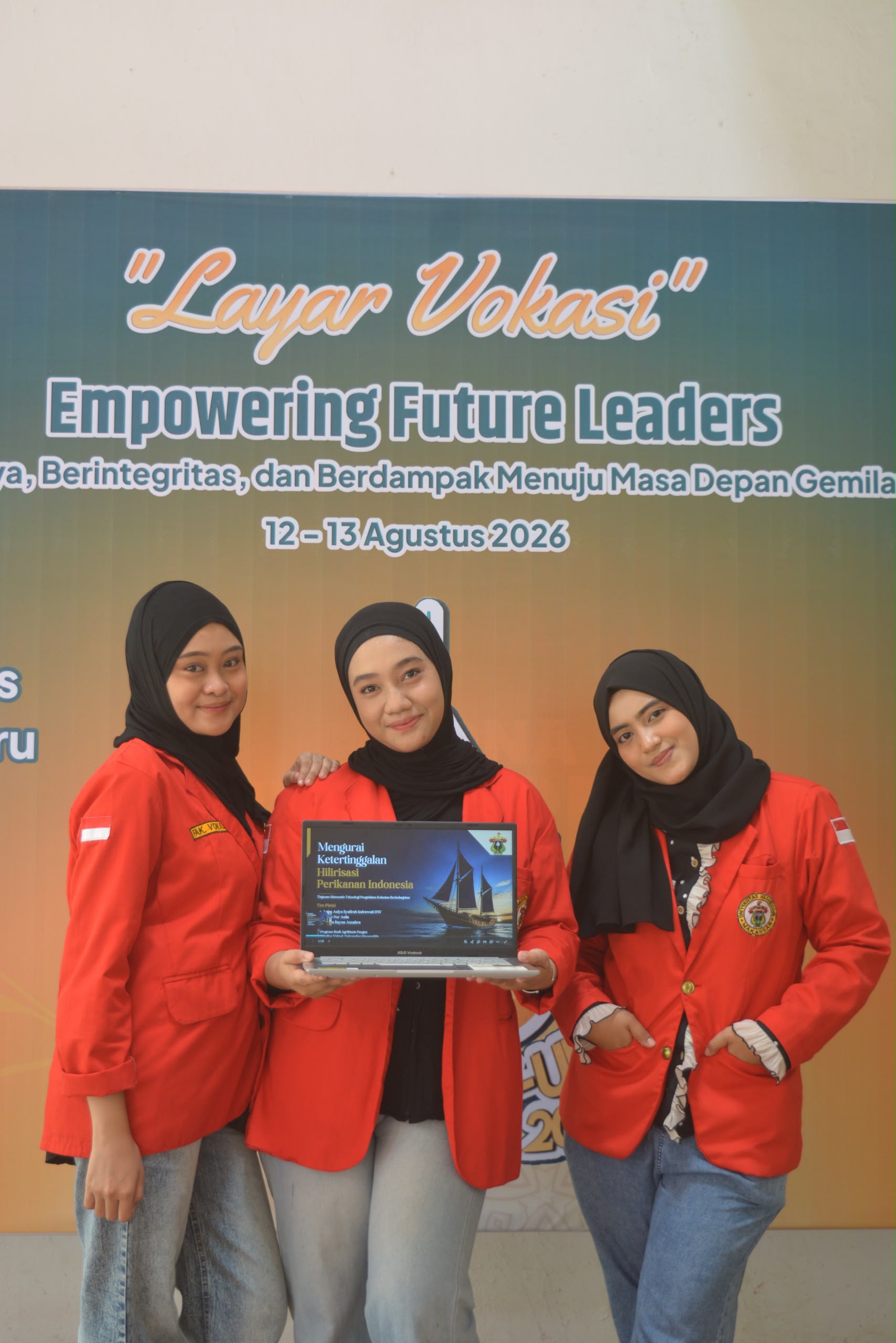
Addressing Indonesia’s Fisheries Downstreaming Challenges, Hasanuddin University Vocational Students Win First Place at National Competition
MAKASSAR – Indonesia is blessed with vast marine resources and abundant fisheries production. Yet, this wealth has not been fully matched by the country's capacity to transform marine products into higher-value commodities. It is a longstanding challenge that continues to invite discussion, including among university students.
Taking this issue as their starting point, three students from the Food Agribusiness Study Program, Faculty of Vocational Studies, Hasanuddin University (Unhas), namely Anisa Aulya Syafirah, Nasila Nur Aulia, and Zaskia Rayna Azzahra, secured first place in the National Agromaritime Scientific Writing Competition.
Their award-winning paper, entitled “Unraveling the Gaps in Indonesia’s Fisheries Downstreaming: A Systematic Review of Sustainable Seafood Processing and Preservation Technologies,” explores a critical question facing the country's fisheries sector.
The title may be lengthy, but the issue at its heart is straightforward: how can Indonesia move beyond selling raw marine commodities and instead develop processed, preserved, and higher-value seafood products?
Through a systematic review approach, the paper examines seafood processing and preservation technologies within the broader context of sustainable fisheries development. The topic is particularly relevant to Indonesia, where post-harvest handling, product quality, and value creation remain important challenges in strengthening the fisheries industry.
The national competition brought together 62 teams from universities across Indonesia, with 41 participating in the scientific writing category and 21 in the scientific poster category. Among these participants, the Hasanuddin University team emerged as the first-place winner.
Perhaps the most compelling aspect of this achievement lies beyond the trophy or the recognition itself. It is the willingness of young scholars to engage with a longstanding issue in Indonesia's marine and fisheries development and bring it into academic discussion through a systematic examination of existing knowledge.
After all, discussing Indonesia's marine wealth should involve more than simply counting the volume of fish harvested each year. An equally important question remains: how much economic value can be preserved and generated once those catches reach the shore?
The achievement marks a proud moment for the Food Agribusiness Study Program, Faculty of Vocational Studies, Hasanuddin University. It also highlights the broader role of vocational education in connecting academic knowledge with real-world industrial challenges, particularly at the intersection of technology, seafood processing, and economic sustainability.
Winning first place is certainly an accomplishment worth celebrating. Yet, the ideas behind this achievement point to a much larger question: how can Indonesia ensure that the economic value generated from its marine resources truly reflects the richness of the seas it possesses?