Oleh: Rifqah Jihan Ashilah
On the southern coast of Central Papua lies a small town called Kokonao. Although not as popular as the old towns of Java or Sumatra, Kokonao has a historical significance that is no less important. Since the early 20th century, this town has been the centre of Catholic missions and Dutch colonial rule. The old buildings that still stand today are not merely physical relics, but reflections of the social, cultural and political dynamics of the past.
Since the early 20th century, Kokonao has been the centre of Catholic missions and Dutch rule in the Mimika region. Colonial buildings such as churches, mission houses, and district offices were built in a distinctive style, but did not completely imitate Europe. Instead, they showed adaptation to the tropical climate and geographical conditions of the Papuan coast by using stilt houses, local materials, and open ventilation. This was not only a matter of building techniques, but also of how colonial powers adapted to local realities.
Unfortunately, despite its high historical and architectural value, Kokonao has not received much attention in urban archaeological studies. In fact, this city has great potential for understanding how colonial spaces were formed, lived in, and inherited. Its spatial layout shows a clear division between the centre of government, the mission area, the trading area, and the community settlement, a pattern that reflects both the colonial social structure and local dynamics.
This research stems from the question: how did colonial architecture and urban planning in Kokonao come about, and to what extent did they adapt to the local environment? Through an archaeological approach, we are invited to explore the spatial narrative that shaped the identity of this old town.
Kokonao is not only an old town that preserves colonial traces, but also a living laboratory of how architecture can negotiate with nature. The colonial buildings here were not built in a rigid, purely European style, but rather demonstrate an ability to adapt to the humid, hot and dynamic coastal environment of Papua.
The colonial buildings in Kokonao show a unique adaptation to the coastal environment. Stilt houses, the use of local woods such as ironwood, and open ventilation are characteristic features of the architecture in this region. Unlike pure European styles, these buildings combine colonial construction techniques with local wisdom, creating forms that are both functional and contextual.
For example, the rectory and nunnery complex in Kampung Apuri is still in active use and displays a sturdy, simple, and climate-friendly structure. These buildings were not only residences but also centres for education and health services during the colonial period.
One of the most striking forms of adaptation is the use of stilt houses. Given the geographical conditions of low-lying land and extreme tidal fluctuations, stilt houses are a clever architectural solution. Buildings such as the rectory, mission teacher's house, and nunnery dormitory are built on sturdy pillars made of ironwood or a mixture of cement and stone, keeping the floors dry and ensuring good air circulation.
Local materials are also the primary choice. Sowang wood and gaba-gaba (woven sago leaves) are used for walls and floors, not only because they are readily available, but also because they are resistant to the tropical climate. The roofs of the buildings use zinc or asbestos with a steep slope, allowing rainwater to flow quickly and reducing the risk of leaks. Natural ventilation is enhanced by wide windows and wire mesh screens, creating cool, bright spaces without relying on modern technology.
Interestingly, these adaptations are not only technical, but also social. Colonial buildings in Kokonao were designed to serve multiple functions—as residences, educational centres, health services, and places of worship. Their layout also took into account wind direction, access to rivers, and proximity to local communities. This shows that colonial architecture in Kokonao was not simply an "import of European style," but rather the result of negotiations between colonial powers and local realities.
In an archaeological context, these buildings serve as evidence of how humans designed spaces to survive and function in challenging environments. Architectural adaptation in Kokonao reflects a process of learning, modification, and integration between colonial culture and local Papuan wisdom. To this day, many of these buildings still stand and are in use, serving as silent witnesses to living history.
The spatial pattern that has developed in Kokonao is not the result of spontaneity, but rather a reflection of planned colonial intervention. Since its establishment as a district within the Afdeling Nieuw Guinea Barat region in 1937, Kokonao has been designed as a centre of government and Catholic missions. The placement of important buildings such as churches, rectories, teachers' houses and Bestir offices followed the logic of power and service, while also taking into account access to rivers and the sea as the main means of transportation.
Kokonao displays a clear division of space: the administrative centre, the mission area, the trading area, and the community settlement. This pattern reflects colonial intervention in the traditional spatial structure. Important buildings such as the district office, church, and Dutch officials' houses were strategically placed near river and sea routes, facilitating access and control.
The distribution map of old buildings shows a concentration of colonial relics in six main villages: Apuri, Kokonao, Migiwia, Mimika, Kiyura, and Atopo. Each village has a different character and function, but they are interconnected in a colonial city network.
The city's spatial layout shows a structured and hierarchical pattern, where each zone has a clear and interrelated function. In the city centre stand key buildings such as the district office, church and Dutch officials' residences. This location was not chosen at random—it is close to the river and sea, facilitating logistics and administrative control. Surrounding it are scattered mission settlements, trading areas and local people's houses, forming layers of space that reflect social status and economic function.
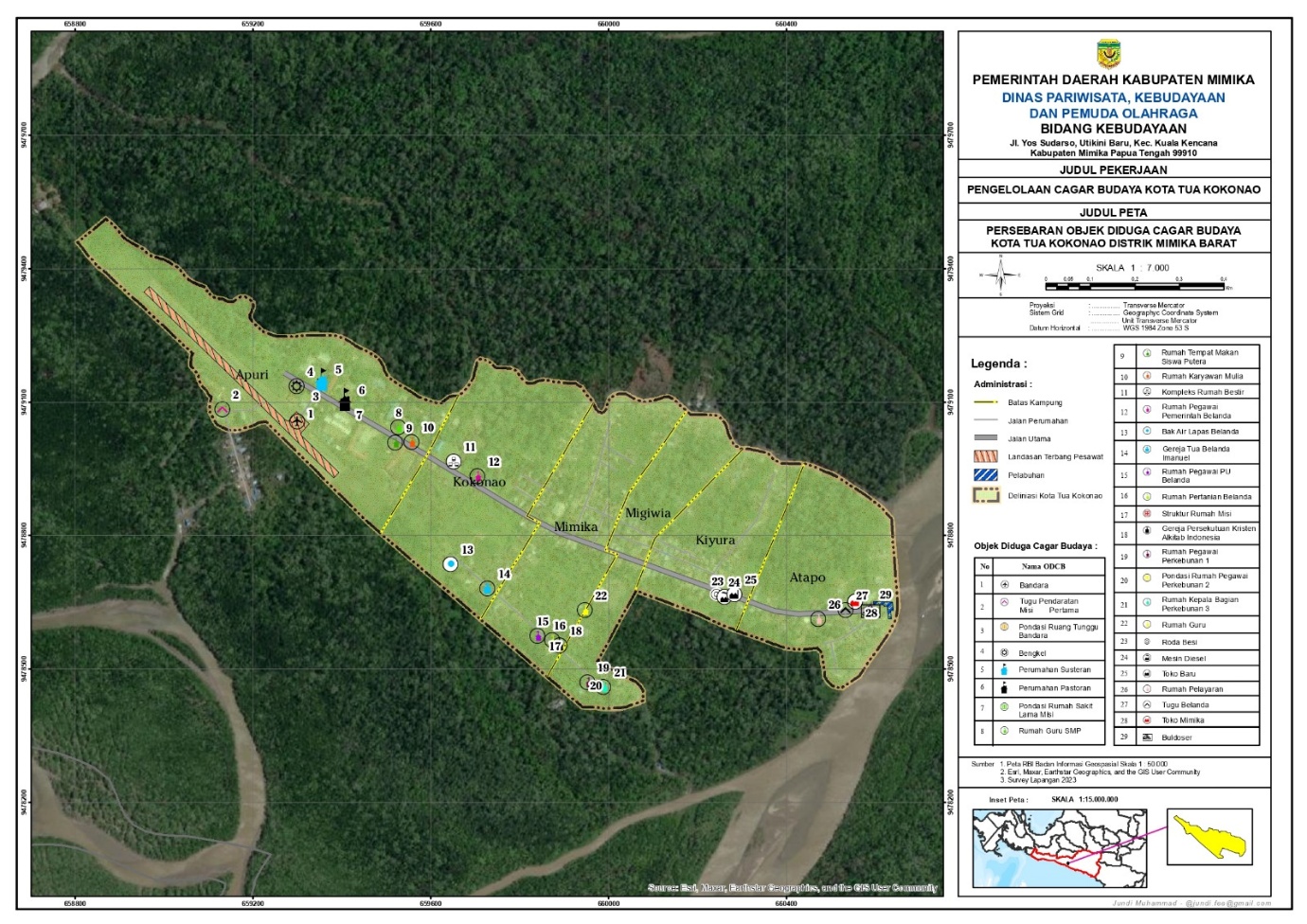
The mission settlement occupied a strategic position in Apuri Village, complete with educational and religious facilities. Meanwhile, government settlements were scattered across Kokonao, Migiwia, and Mimika, featuring official residences, administrative offices, and other colonial buildings. Merchant settlements, mainly from the Chinese and local communities, developed around the port and market, demonstrating their vital economic function in the city's structure.
This pattern shows that Kokonao's spatial layout was designed to support the colonial system: the centre of power in the middle, surrounded by supporting zones. Mission settlements were strategically placed in Kampung Apuri, complete with a rectory, dormitories, and a mission airstrip. Meanwhile, government settlements were scattered across Kokonao, Migiwia, and Mimika, with official residences, Bestir offices, and public facilities. On the other hand, villages such as Kiyura and Atopo became centres of commercial activity, with shops and shipping houses that have been active since colonial times.
In spatial archaeological studies, Kokonao is a clear example of how urban space can reflect social relations, environmental adaptation, and historical dynamics. The hierarchy of spatial functions in this city is not merely a layout of buildings, but a narrative of how humans organise, fill, and inhabit their space.
The colonial buildings in Kokonao are not only architectural artefacts, but also part of the collective memory of the community. Many buildings are still used, maintained or remembered by local residents. Missionary houses, Chinese shops and old churches symbolise the connection between the past and the present.
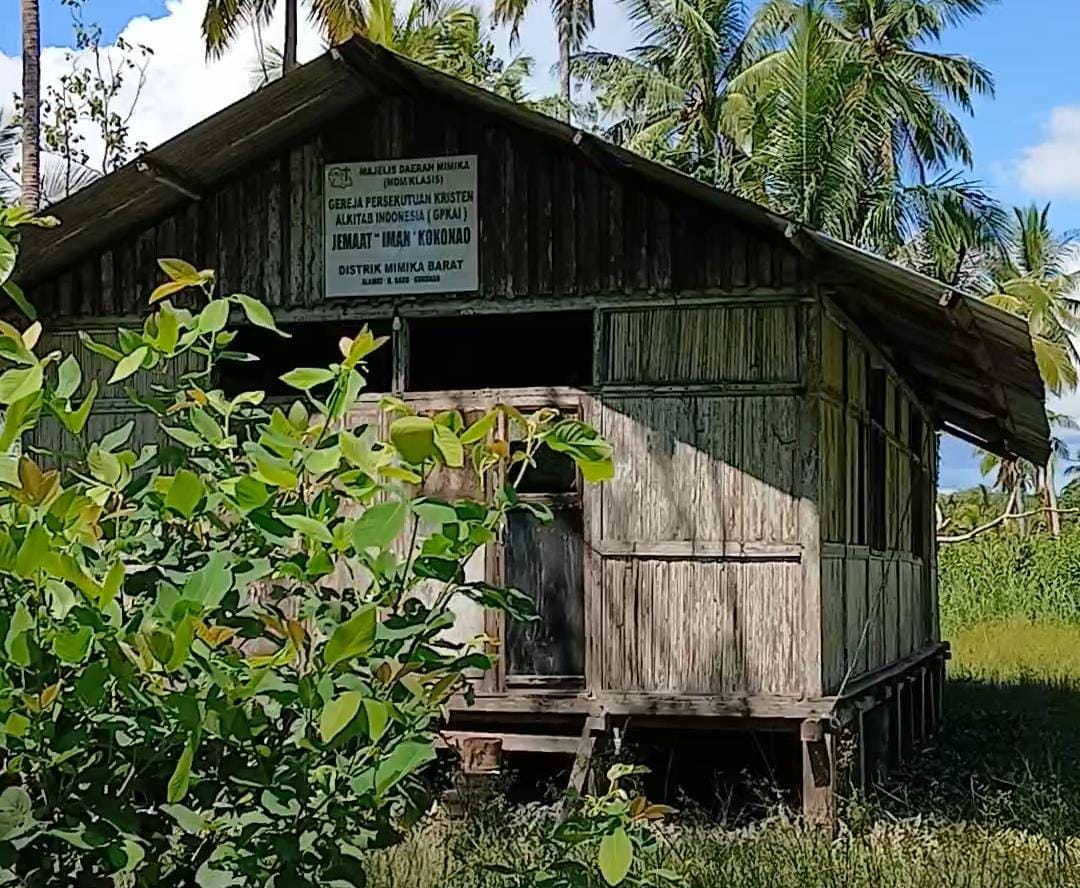
However, some buildings have been damaged or lost. Its status as a Suspected Cultural Heritage Site (ODCB) indicates the need for preservation and official designation so that this heritage is not lost to time.
Kokonao is not just an old town with colonial buildings; it is a living space that records traces of encounters, struggles and changes. Behind the ironwood walls and rusting zinc roofs lie stories of the Catholic mission era, Dutch rule, and the lives of local communities that continue to adapt.
Many colonial buildings in Kokonao still stand and are used today. The mission teachers' house, the old church, and the nuns' dormitory are not just architectural structures, but also spaces that hold collective memories. It was there that the first generation learned to read, received health services, and got to know the outside world. These buildings are silent witnesses to the social transformation that has taken place over decades.
However, not all of these legacies have survived intact. Some buildings have been damaged, lost, or repurposed. Some are now schools, while others are reduced to their foundations. Even so, their existence remains important because cultural heritage is not only about physical objects, but also about values, memories, and identity. In archaeological studies, the collective memory of the community regarding colonial buildings is data that is no less important than artefacts. Interviews with local residents show that many of them still remember the old functions of the buildings, even mentioning the names of priests, teachers, or colonial officials who once lived there. These memories serve as a bridge between the past and the present, strengthening a sense of ownership of the existing cultural heritage.
The preservation of colonial buildings in Kokonao is not only about maintaining their physical form, but also about preserving the narratives that live within them. As long as the community continues to remember, use, and maintain these old buildings, the cultural heritage will never truly die. It continues to live on in daily practices, in the stories that are told, and in the spaces that remain inhabited.
Kokonao teaches us that cultural heritage does not only belong to the past, but also to the future. It is a resource for understanding who we are, where we come from, and how we can design more meaningful spaces.
Kokonao is not merely a geographical point, but a historical space that holds narratives of colonialism, local adaptation, and social transformation. The colonial architecture in this city shows how power, religion, and culture interact in shaping space. The city layout that was formed during the Dutch colonial period is still recognisable, despite undergoing changes.
Through archaeological studies of colonial buildings and urban layout, this research shows that Kokonao is a concrete example of how space can be a silent witness to cultural encounters, power, and human adaptation to nature. Colonial buildings in Kokonao, such as the rectory, mission teacher's house, and Bestir office, were not built in a rigid European style. Instead, they feature stilted houses, the use of local wood, and open ventilation—all designed to cope with the tropical climate and tidal fluctuations. This adaptation is not only a matter of construction techniques, but also a reflection of the negotiation process between colonialism and local wisdom.
Scientifically, this finding enriches urban archaeological studies in Eastern Indonesia, which have received little attention thus far. Buildings such as the rectory, mission teacher's house, and Bestir office demonstrate adaptation to the tropical environment, use of local materials, and zoning patterns that reflect the colonial social structure. This study opens up space for interdisciplinary studies between architecture, history, anthropology, and urban planning to understand how colonial spaces were transformed into meaningful local spaces.
The urban layout also shows a structured pattern: the centre of government and missions in the heart of the city, surrounded by commercial areas and community settlements. This pattern reflects the social hierarchy and spatial functions designed to support the colonial system, but in practice, the local community also shaped and inhabited these spaces. Buildings that once belonged to the colonials are now repurposed, maintained, or commemorated by local residents, demonstrating that space is never static but constantly changing and adapting.
The most touching aspect of this discovery is how Kokonao remains a living historical space. It is not a frozen open-air museum, but a city that still pulsates with activity, memories and hopes. The colonial buildings that still stand are not just artefacts, but also part of the daily life of the community. They are homes, places of worship, schools and even social meeting points that strengthen the sense of community.
In the context of preservation, Kokonao offers an important lesson: that cultural heritage does not have to be preserved in its original, monumental form. Rather, when the community continues to use, maintain, and remember these old buildings, the heritage remains alive and meaningful. Kokonao is proof that colonial spaces can be transformed into inclusive, adaptive, and meaningful local spaces.
The preservation of colonial buildings in Kokonao is not only about maintaining the physical structure, but also about preserving the memories and identity of the community. This study is expected to enrich urban archaeological studies and encourage efforts to protect cultural heritage in Papua. Thus, Kokonao is a living historical space—not an open museum, but a city that continues to pulsate with activity and memories. It teaches us that cultural heritage preservation must involve the community, respect the local context, and open up space for younger generations to recognise and love their own history.
Ketik minimal 2 karakter lalu tekan Enter