Teen Language in the Digital Age: Digital Humanities Reveal Generation Z’s Linguistic Dynamics
MAKASSAR - Teen language in the digital era continues to evolve as a form of expression and group identity. Digital Humanities offer new ways to understand Generation Z’s linguistic dynamics through data-driven analysis.
Professor Munira Hasjim, a senior scholar of Indonesian Literature at the Faculty of Cultural Sciences, Universitas Hasanuddin (FIB Unhas), highlighted the transformation of Indonesian among youth as a complex linguistic phenomenon worth exploring through Digital Humanities.
The former Head of the Indonesian Literature Department at Unhas explained that Digital Humanities is an interdisciplinary field combining computational technology with humanities studies, enabling large-scale linguistic data analysis that was previously difficult to conduct manually.
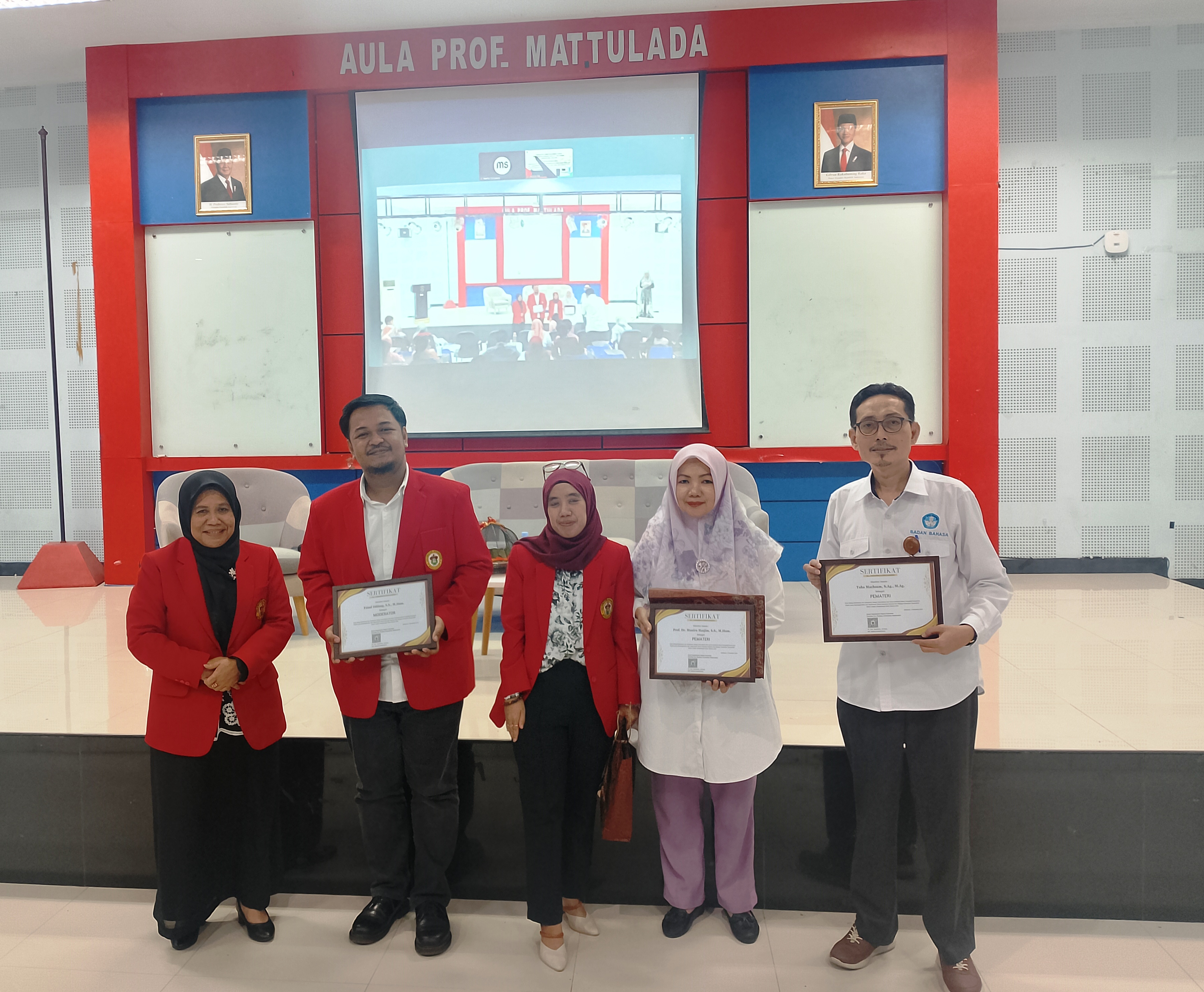
“Youth language on social media is a rich subject of study,” she said during a language and literature dialogue titled “Indonesian Language and Literature in the Perspective of Digital Humanities”, held at the Mattulada Hall, FIB Unhas, on Monday, November 3, as part of Language Month celebrations organized by the Indonesian Literature Department.
The event also featured two other speakers: Martin Suryajaya from the Jakarta Institute of the Arts and Toha Machsum, Head of the Language Office of South Sulawesi Province.
According to Prof. Munira, digital platforms such as social media and messaging apps have become primary spaces for Generation Z to express themselves, creating dynamic, innovative, and ever-evolving forms of communication. Terms like “anjir”, “bacot”, “bussin’”, “red flag”, and “green flag” are not just trends—they signify group identity and solidarity. Teen slang draws from regional languages, Indonesian, foreign languages, and hybrids of all three, producing neologisms that enrich everyday vocabulary while challenging formal language norms.
Extreme examples like “ndk brtemanki” illustrate grammatical violations that may weaken the structure of standard Indonesian. On the other hand, the shift from pure text to multimodal forms—combining text, emojis, and images—has given rise to new forms of literacy that are more expressive and contextual.
In research contexts, Digital Humanities enable the analysis of linguistic big data from digital platforms using computational tools. Methods include automated text analysis to identify word patterns, slang frequency, and sentence structure changes; social network mapping to track the spread and adoption of new terms in online communities; and data visualization to present language usage trends across time and platforms.
Prof. Munira also outlined distinctive linguistic features of digital youth, such as code-mixing that blends English, Indonesian, and local particles in expressions like “first acound mo” or “ndk brtemanki di secondd kuu”. She noted the use of acronyms and abbreviations like “mager” (too lazy to move), “bucin” (love slave), and “japri” (private message) as strategies for communication efficiency. Multimodal communication using emojis, stickers, and GIFs further enhances message expression in digital interactions.
She concluded by emphasizing the importance of strategies to preserve the Indonesian language in digital spaces. Recommended steps include regulating the use of Indonesian on official digital platforms, launching creative campaigns on social media, promoting language learning based on digital literacy and real-life contexts, and encouraging parental guidance and youth responsibility in using language ethically and appropriately. (*)