Public Lecture of Indonesian Literature, FIB Unhas: Exploring Chinese Culture Through Ancient Buildings in Fengchang City
MAKASSAR – Ancient buildings are not merely stone and wood, but living traces that preserve philosophy and civilization. This public lecture by the Indonesian Literature Department at FIB Unhas opened a window into cross-cultural understanding, inviting students to explore the symbolic meanings of Chinese heritage from Fengchang City.
The Department of Indonesian Literature, Faculty of Cultural Sciences (FIB), Hasanuddin University (Unhas), together with inbound students from the Indonesian Literature Study Program, held an international-scale academic activity.
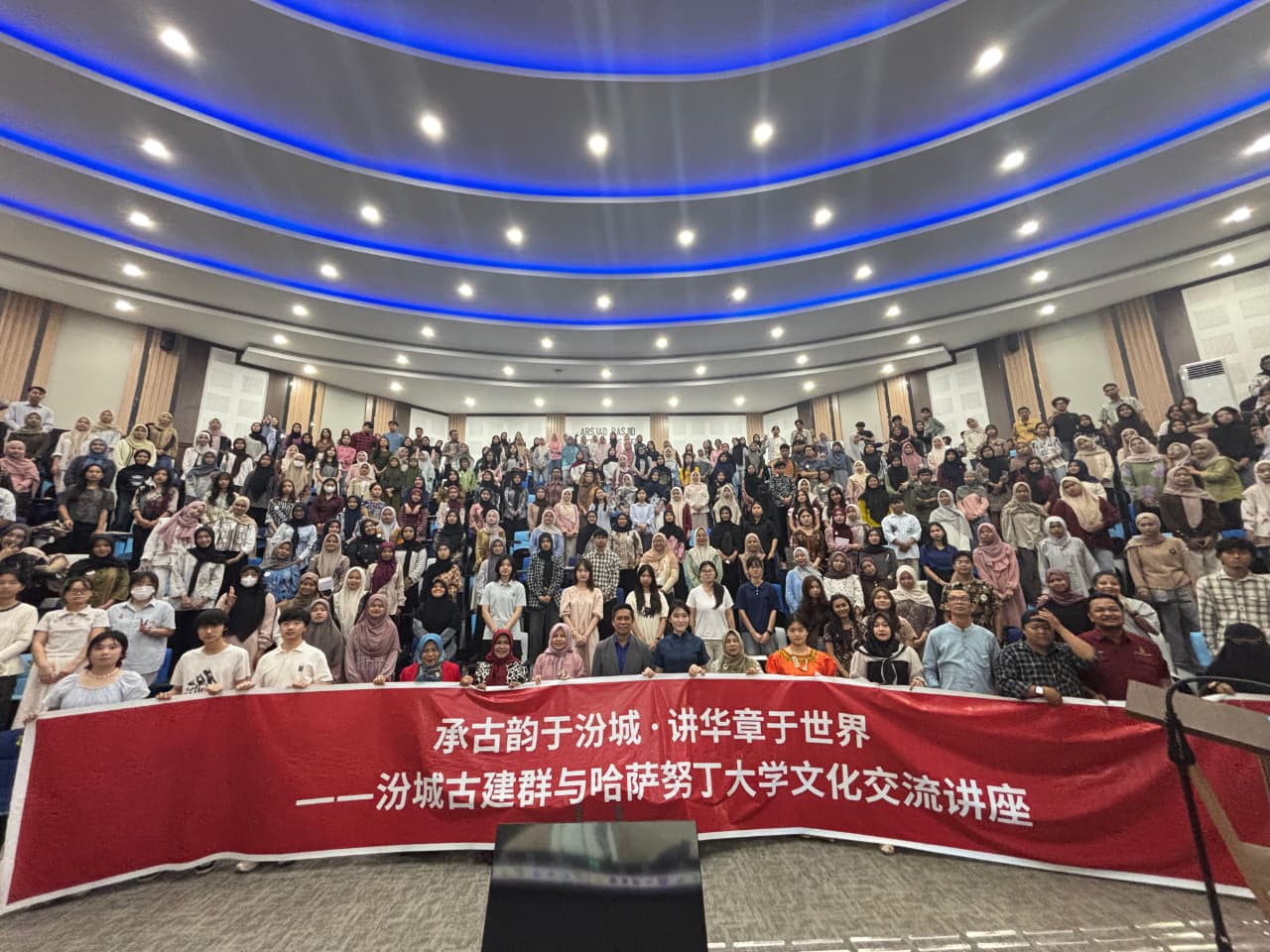
A total of 13 students from Hefei University of Technology, China, who are currently participating in a student exchange program at Unhas, actively joined the public lecture entitled “Exploring Chinese Culture Through Ancient Buildings in Fengchang City.”
The event took place from morning until noon at the Arsjad Rasyid Lecture Theatre on Tuesday, December 2, 2025, attended by hundreds of students from various majors. The lecture featured Li Xiao Fang, Deputy General Director of Tourism and Cultural Development at Zhong Yuan Co. Ltd., who delivered the material online via Zoom directly from Fengchang, China. The Dean of FIB Unhas, Prof. Dr. Andi Muhammad Akhmar, S.S., M.Hum., officially opened the event.
This year’s inbound program of Indonesian Literature FIB Unhas was joined by 13 students from Hefei University of Technology, China. Their presence is part of a long-standing linguistic collaboration between Unhas and educational institutions in China.
Dr. Dra. Muslimat, M.Hum., Head of the Indonesian Literature Department at FIB Unhas, emphasized that this public lecture was not merely a space for sharing knowledge, but also a step toward expanding cultural networks and academic opportunities with institutions in China. She added that such networks open doors for Unhas students to study and conduct research on Chinese culture and history.
Dean Prof. Dr. Andi Muhammad Akhmar also highlighted the importance of cross-cultural activities. According to him, knowledge from the past holds great value. “This can enrich our understanding, enabling cultural exchange,” he explained. He noted that ancient buildings are full of philosophy reflecting ideology and cultural elements, similar to Bugis traditional houses which also carry their own philosophical meanings.
The lecture was moderated by Luna (Jing Chunlu), one of the inbound students from Hefei. In his presentation, Li Xiao Fang invited participants to explore cultural symbols found in ancient Chinese architecture.
He delivered the lecture directly from the Confucius Temple in Fencheng, Shanxi Province, a historic site dedicated to honoring Confucius. He introduced the Dacheng Hall (大成殿), the main building that has stood for nearly 700 years.
On its roof are four small animals symbolizing strength and good fortune: the dragon, phoenix, lion, and heavenly horse (tianma). He also showcased the Yuetai, a stage used for ceremonial performances or Confucius’ birthday celebrations, functioning like modern performance stages but imbued with spiritual meaning.
Li Xiao Fang emphasized Confucius’ educational philosophy reflected in a wooden carving of a shepherd boy. The carving symbolizes the idea “有教无类 (You jiao wu lei)” – that everyone has the right to learn regardless of social status. Confucius is known as the founder of private education in China, with more than 3,000 disciples during his lifetime.
He also mentioned a calligraphy displayed at the United Nations headquarters that reads “四海之内皆兄弟也” – “Under heaven, all men are brothers.” This phrase, from the Analects (Lunyu), reflects the universal values of peace and unity among civilizations.
Additionally, Li presented lotus carvings and the water bird lùsī (鹭鸶), symbolizing prayers for smooth success in examinations. This motif is known as “一路连科” – continuous success in passing exams.
As the year 2025 turns into 2026, which in the traditional Chinese calendar is the Year of the Horse, Li conveyed blessings and hopes through expressions such as 一马当先 (taking the lead), 马到成功 (instant success), and 旗开得胜(victory from the start). These phrases symbolize optimism and achievement in the new year.
To conclude, Li Xiao Fang introduced the Kuixing Tower (魁星楼). In traditional Chinese culture, Kuixing is the deity overseeing learning, academic advancement, and state examinations. People believe Kuixing marks a person’s name with the pen he holds as a symbol of academic success. The Kuixing Tower thus represents the hope that students will achieve excellence in education – a message highly relevant to Unhas students attending the lecture.
The enthusiasm of participants was evident from the large number of students across disciplines who attended and actively engaged in the dialogue. Those who asked questions also received gifts sent directly from China.
The agenda “Exploring Chinese Culture Through Ancient Buildings in Fengchang City” stands as tangible proof of the commitment of Indonesian Literature FIB Unhas to strengthen international cooperation, particularly with educational institutions in China. Beyond enriching cross-cultural insights, it also fosters closer academic relations between Indonesia and China. (*)


