
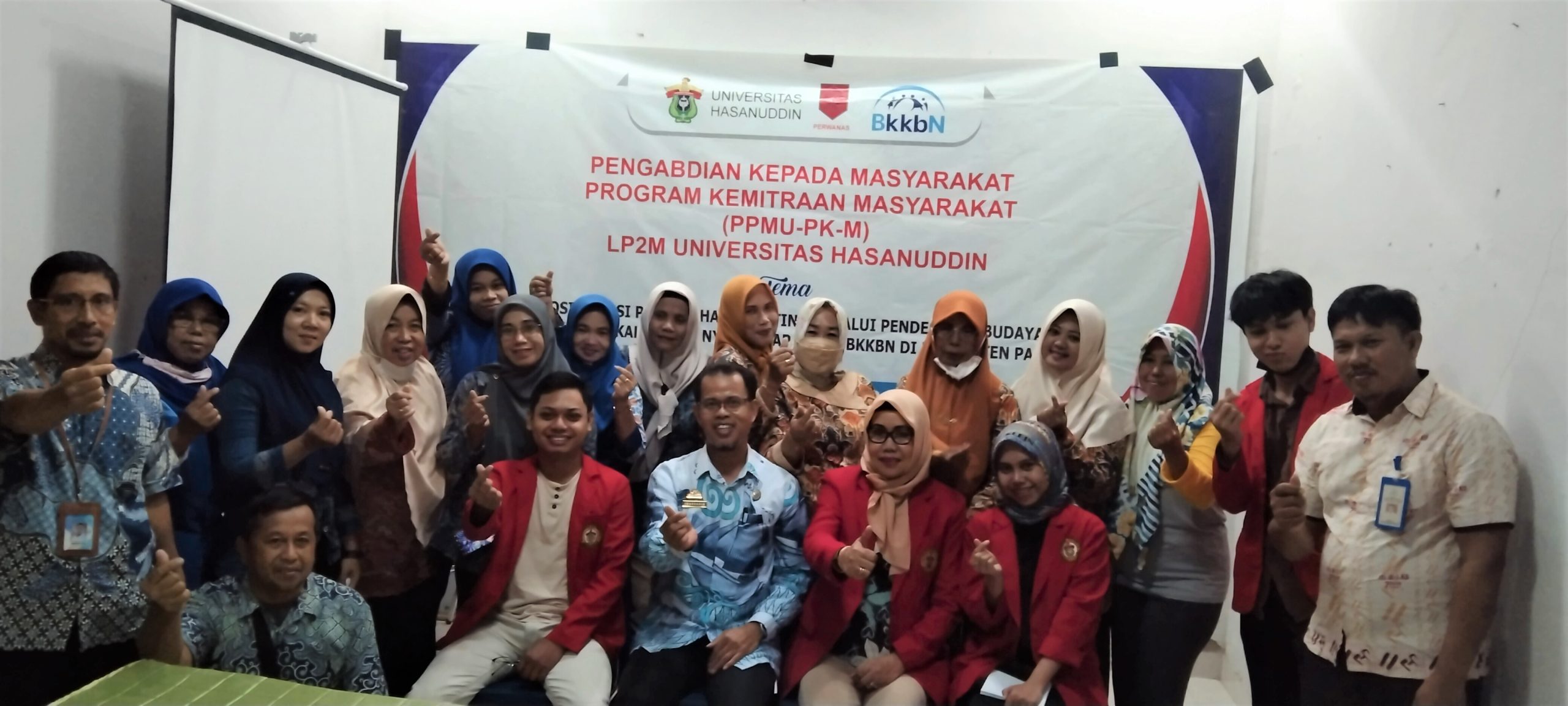
Tackling Stunting Through Local Wisdom, Indonesian Literature Department of Unhas Collaborates with DPPKB Pangkep
PANGKEP – Addressing stunting requires a cross-disciplinary approach. Not only through health sciences, but also by incorporating cultural perspectives. This interdisciplinary discussion was raised during the Socialization of Stunting Prevention through Cultural Approaches and Local Wisdom for BKKBN field instructors in Pangkep, Thursday, July 7, 2022.
This collaboration involved the Office of Population Control and Family Planning (DPPKB), Women’s Empowerment and Child Protection (P3A) Pangkep, together with the Community Service Team of the Partnership Program (PPMU-PK-M) LP2M Unhas.
Muh Imanuddin Taqwa Karim, Head of KBKS at DPPKB Pangkep, explained that stunting is a chronic nutritional problem characterized by a child’s failure to grow and develop optimally.
This condition is caused by cumulative and continuous nutritional deficiencies, resulting in children being too short for their age. “Chronic malnutrition occurs from the time the baby is in the womb and during the early stages after birth. Stunting only becomes visible when the child reaches the age of two,” he said.
He emphasized that stunting prevention must begin during the golden period of the First 1,000 Days of Life (HPK). “This period spans from pregnancy until the child reaches two years old,” he explained.
During this time, brain growth is very rapid, supporting the child’s overall development. “Nutritional deficiencies during this golden period cannot be corrected later in life,” he stressed before the BKKBN field instructors in Pangkep.
He added that malnutrition impacts children’s health: “Children may lack intelligence due to inhibited brain growth, be at risk of stunting due to impaired physical growth, become weak and sickly, and struggle to keep up with lessons at school.”
To address stunting, he outlined two strategies: specific interventions and sensitive interventions targeting the first 1,000 days of life. Steps for mothers include prenatal checkups, adequate nutrition during pregnancy, and iron supplementation.
Other measures include giving birth in health facilities, early initiation of breastfeeding (IMD), exclusive breastfeeding, complete basic immunization, monitoring growth at posyandu (BKB), ensuring clean water, practicing healthy living behaviors (PHBS), and maintaining environmental sanitation. “The government has also issued Pangkajene and Islands Regent Regulation No. 23 of 2020 on Stunting Prevention and Reduction,” he added.
Dr. Inriati Lewa, Head of the Unhas Community Service Team, shared insights on addressing stunting through culture and local wisdom. She cited the traditional concept of marital readiness, expressed in the saying “ready to circle the kitchen seven times.”
The true meaning, she explained, is not about literally circling the kitchen, but about maturity in building a household—knowledge and emotional readiness. With this understanding, early marriage can be prevented, as one of the causes of stunting is marrying too young.
“Stunting is not only a health issue; it is also cultural. Local wisdom plays a role,” emphasized the Unhas Indonesian Literature lecturer.
She reiterated that reducing stunting requires cross-disciplinary collaboration—not only health approaches but also cultural ones. This method can be applied in Pangkep. She also highlighted positive national trends in stunting reduction: in 2018 it decreased by 1.3% per year, in 2019 by 1.7% per year, and in 2021 it dropped to 24.4%.
Another speaker, Ilham, an alumnus of the Master’s Program in Indonesian Language at FIB Unhas, explained the close relationship between child nutrition and the mother’s kitchen. Mothers manage children’s nutrition and food readiness. He encouraged local wisdom practices such as planting vegetables and herbs in home gardens. “From moringa, lemongrass, to other spices—these can serve as alternative food security sources from the household yard,” he said. (*)