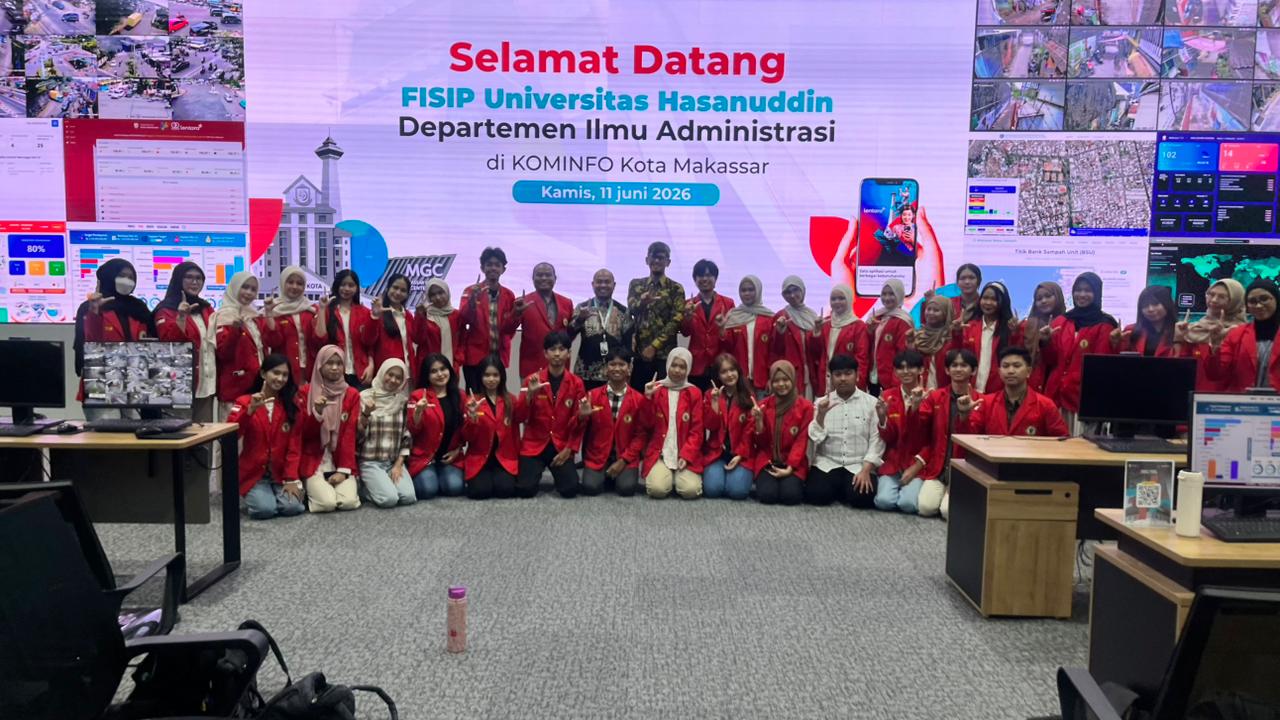
MAKASSAR – A different atmosphere filled the Makassar Command Center (MCC) on Thursday, June 11, 2026. Dozens of students sat neatly in rows, their eyes fixed on large screens displaying thousands of citizen complaints in real time. They were not mere spectators. They were students enrolled in the Public Management course, part of the Bachelor’s Program in Public Administration within the Department of Administrative Sciences, Faculty of Social and Political Sciences, Hasanuddin University. They had come to learn firsthand how public governance is implemented digitally in the city of Makassar.
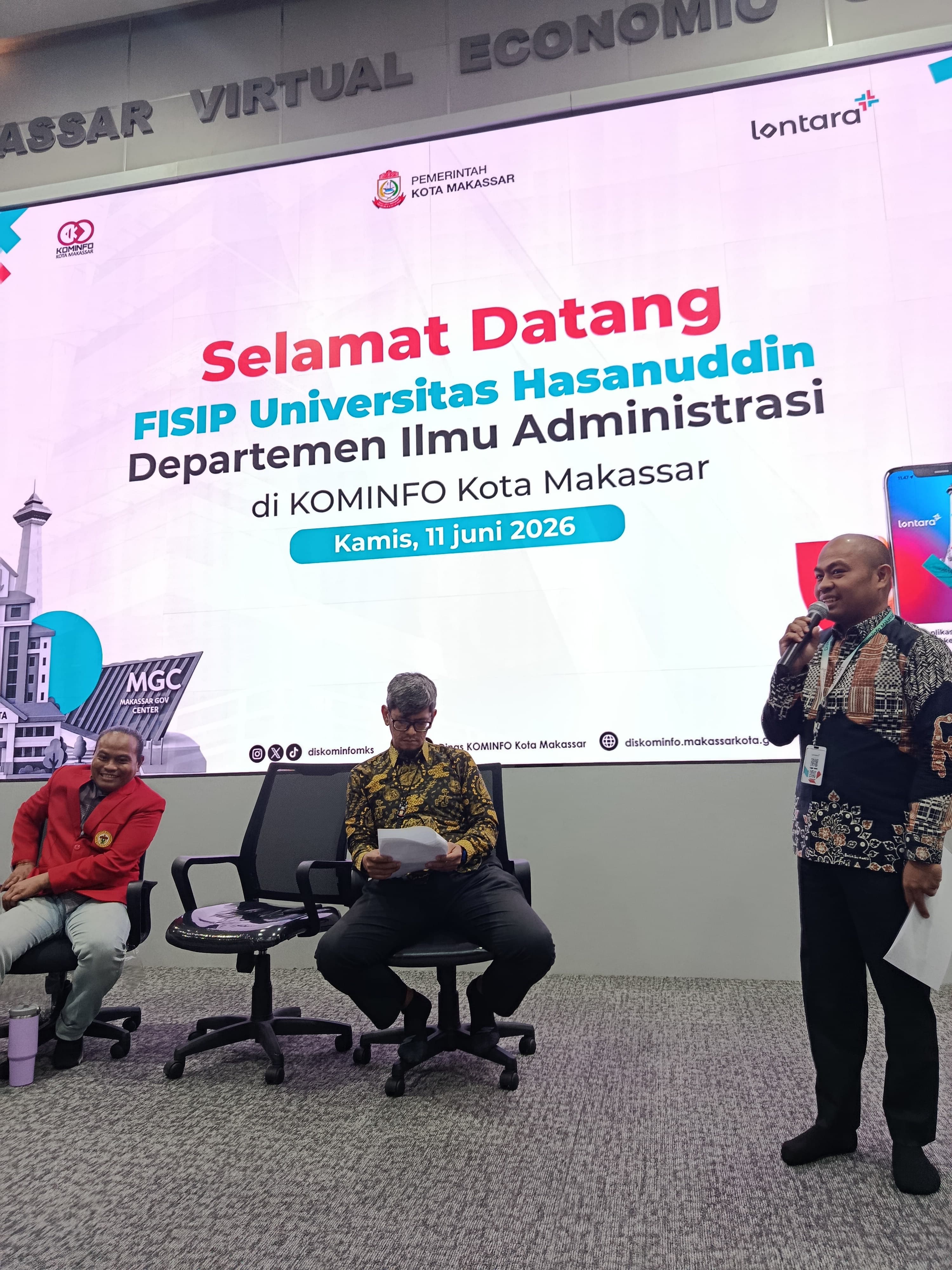
A total of 36 students, accompanied by their instructor, Dr. Ishak Salim, were warmly welcomed by the Head of the Makassar City Communication and Information Technology Agency, Dr. Muhammad Roem, along with his staff. This three-hour visit served as a space for dialogue between classroom theory and field practice.
Speaking to the students, Dr. Muhammad Roem emphasized that digital transformation in Makassar is not solely focused on bureaucratic efficiency. More than that, he wants to ensure that technology truly fosters citizen participation as partners of the government.
“The Makassar Command Center is proof that public services cannot operate in isolation. We are building a collaborative network across government agencies, the public, and the digital community. Every citizen report—whether it goes viral or not—is treated equally and resolved promptly. There must be no more discrimination in handling these reports,” he stressed.
He also explained that the MCC currently manages thousands of complaints every day through various channels, ranging from the Sombere and Lontara apps, social media, to the 112 call center. Data from various departments—such as Social Affairs, Population, and Health—is integrated into a single dashboard, making the resolution of residents’ issues faster and more measurable.
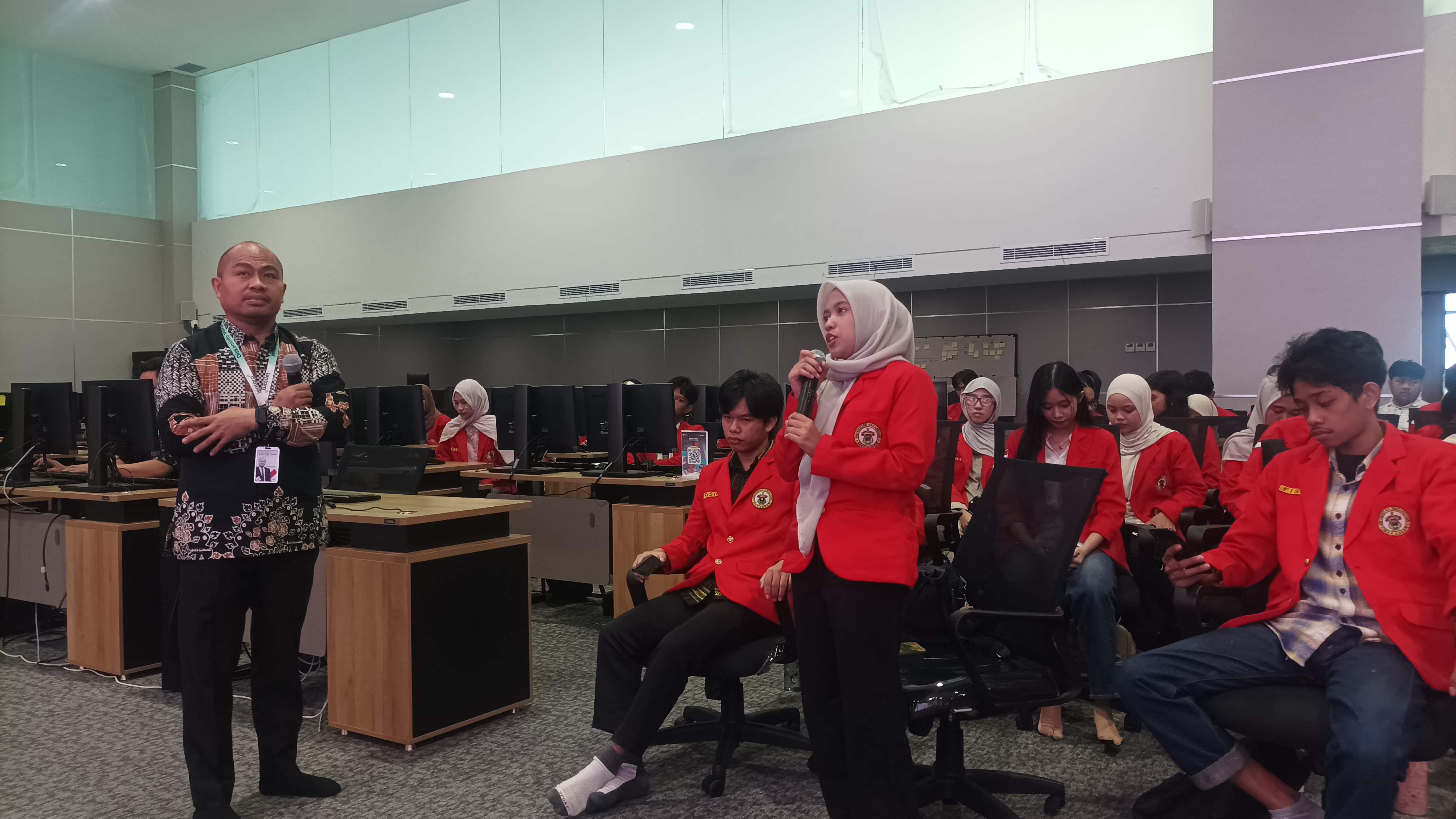
Furthermore, Dr. Ishak Salim, the instructor for the Public Management course, explained that the field study at the Makassar Communication and Information Office was designed to give students hands-on experience with how public management is implemented using digital technology. In addition, this public management is carried out through cross-sectoral collaboration. “We study New Public Governance in class. But today, students are seeing firsthand how the city government builds networks, manages citizen complaints, and ensures that the voices of ordinary citizens are heard. This isn’t just a visit. It’s a tangible example of collaboration between Hasanuddin University and the Makassar City Government to create public services that prioritize participation and have a real impact,” said Dr. Ishak. Dr. Ishak also expressed his appreciation for the openness of the Makassar Communication and Information Office. Students were given the freedom to ask critical questions, ranging from report prioritization and the digital divide to the security of personal data. During the lively discussion session, students did not hesitate to ask in-depth questions. One student highlighted how Diskominfo filters through thousands of daily reports without distinguishing between complaints from ordinary citizens and issues that are currently trending on social media. Dr. Muhammad Roem responded firmly that the prioritization system is determined based on urgency and impact, not popularity. “All reports are treated equally. What sets them apart is how urgent they are and how widespread their impact is on the community,” he explained. Another question concerned the digital divide. Diskominfo acknowledged that not all residents are tech-savvy. Therefore, the government provides support mechanisms through neighborhood unit (RT) and sub-neighborhood unit (RW) leaders, as well as village officials, to assist residents who have difficulty accessing digital services. Reports can also still be submitted offline. Regarding data security, Diskominfo acknowledged that the challenge of data breaches still exists. However, they have implemented a multi-layered system of encryption and personal data protection. Public education efforts are also being actively promoted to encourage people to be more cautious when sharing personal data. At the end of the visit, Dr. Ishak expressed his deep appreciation for the warm welcome and openness shown by the Makassar Communication and Information Agency. “We thank Dr. Roem and his team. We hope this collaboration does not end here. We hope that in the future there will be opportunities for joint research, student internships, and even the development of more participatory public policies. This is the beginning of a strong partnership between the academic world and the government,” he concluded. This visit serves as proof that the synergy between Hasanuddin University and the Makassar City Government goes beyond mere ceremony. More than that, it lays the foundation for creating a form of government that is more open, collaborative, and community-oriented.