FIB Unhas Indonesian Literature Alumni Association Chairman Saharuddin Ridwan Earns Doctorate in Environmental Science
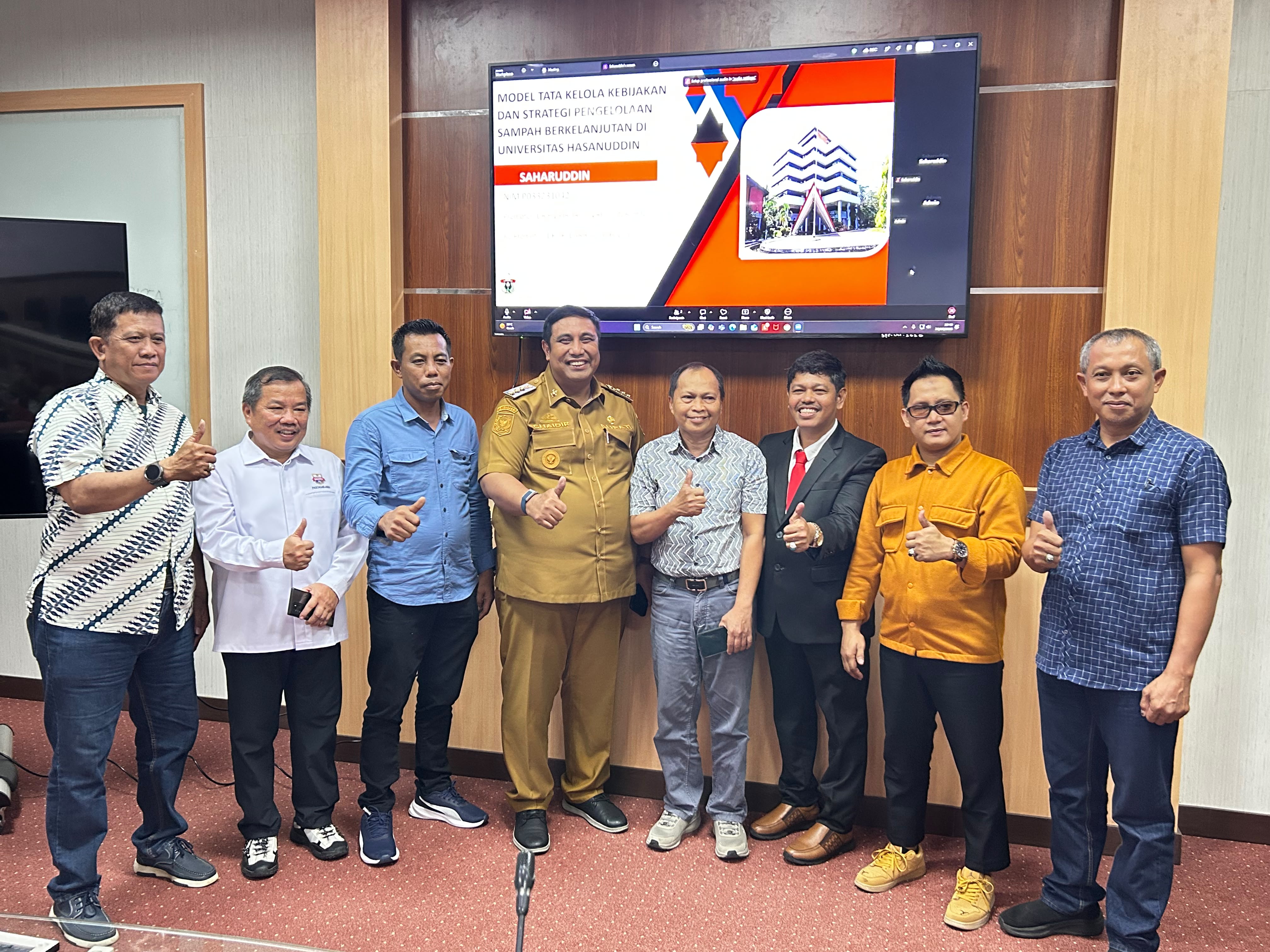
MAKASSAR – Saharuddin Ridwan, Chairman of the Indonesian Literature Alumni Association (IKA) of the Faculty of Cultural Sciences (FIB), Universitas Hasanuddin (Unhas), has earned a Doctorate in Environmental Science from the Graduate School of Universitas Hasanuddin after successfully defending his dissertation during the Final Dissertation Examination held on Tuesday (28 July 2026).
Among alumni and the academic community of the Indonesian Literature Study Program at FIB Unhas, Saharuddin is affectionately known as "Kak Bolong."
The doctoral examination took place in the GB Meeting Room, 2nd Floor, Kuku Building, Graduate School of Universitas Hasanuddin, beginning at 9:30 a.m. local time. During the session, he presented his dissertation entitled "A Governance Model for Policies and Strategies on Sustainable Waste Management at Universitas Hasanuddin."
The dissertation was supervised by Dr. Eng. Irwan Ridwan Rahim, S.T., M.T., and Dr. Darhamsyah, M.Si. The examination committee consisted of Dr. Mini Farida, S.T., M.Si., Prof. Baharuddin, S.T., M.Arch., Ph.D., Prof. Dr. Eng. Adi Maulana, S.T., M.Phil., and Prof. Dr. Eymal Bahsar Demmallino, M.Si.
Since July 2023, Saharuddin has served as President Director of Maros Regency Regional Public Enterprise (Perseroda), where he has focused on strengthening professional corporate governance while supporting regional development.
Saharuddin completed his primary and secondary education in Sinjai Regency, graduating from SDN 150 Sinjai (1984–1989), SMP Negeri 3 Sinjai (1989–1992), and SMA Negeri 1 Sinjai (1992–1994).
He later pursued his undergraduate studies in the Indonesian Literature Study Program at the Faculty of Cultural Sciences, Universitas Hasanuddin, from 1994 to 2000. Several years into his professional career, he continued his education by earning a Master's degree in Human Resource Management from Universitas Muhammadiyah Makassar (2013–2017).
Driven by a lifelong commitment to learning, Saharuddin subsequently enrolled in the Doctoral Program in Environmental Science at the Graduate School of Universitas Hasanuddin, successfully completing his doctoral studies in 2026.
Developing a Sustainable Waste Management Governance Model
Earning a doctoral degree marks another significant academic milestone for Saharuddin, who has long been recognized as an environmental practitioner, social activist, journalist, and professional with extensive experience in regional state-owned enterprises. His academic background in literature did not prevent him from expanding his scholarly expertise and ultimately completing doctoral studies in environmental science.
In his dissertation, Saharuddin examined waste management as one of the major challenges facing higher education institutions in achieving sustainable development. According to him, growing awareness of sustainability issues requires universities not only to serve as centres of knowledge and innovation but also to become role models in implementing environmentally responsible practices.
He explained that global environmental challenges—including climate change, pollution, increasing waste generation, and biodiversity loss—require the active involvement of all sectors of society, including higher education institutions.
"Through the Green Campus concept, universities are encouraged to integrate environmental, social, and economic aspects into all academic and operational activities," said the President Director of PT Bumi Maros Sejahtera (Perseroda).
According to Saharuddin, Universitas Hasanuddin, as one of the largest universities in Eastern Indonesia, has a significant responsibility to establish an effective, integrated, and sustainable waste management system. His research therefore aimed to develop a governance model capable of addressing these challenges while serving as a reference for other higher education institutions.
The study employed a mixed-methods approach, combining quantitative analysis of waste generation and composition across the university with qualitative analysis of policies, regulations, the behaviour of the academic community, and the implementation of existing waste management practices.
The research was conducted systematically through mapping existing policies and waste management systems, formulating sustainability-based strategies, analysing implementation along with supporting and inhibiting factors, and finally developing a comprehensive governance model.
The study resulted in a framework called the "Unhas Model," a sustainable waste management governance model integrating four key dimensions: policy and regulation, operational management, institutional governance, and the circular economy.
The model is expected to serve as a strategic guideline for Universitas Hasanuddin in developing a more effective, sustainable, and adaptive waste management system. Furthermore, it offers a new framework that can be replicated by universities throughout Indonesia in supporting the implementation of Green Campus initiatives.
A Longstanding Commitment to Environmental Sustainability
Saharuddin's academic achievement reflects his long-standing commitment to environmental conservation. For more than two decades, he has actively initiated environmental preservation movements, community empowerment programmes, and waste bank development initiatives.
His dedication has earned him numerous prestigious awards. In 2009, he received the Environmental Champion Award from the Mayor of Makassar for his contributions to promoting environmental awareness within the community.
In 2018, he was honoured by the Governor of South Sulawesi for his contributions to environmental management. In the same year, he also received the To Barania Award from the Mayor of Makassar in recognition of his dedication and service to society.
Beyond his environmental work, Saharuddin has an extensive background in journalism. He began his career as a reporter for Harian Fajar from 2000 to 2002 before serving as a reporter and correspondent for PT Indosiar Visual Mandiri from 2002 to 2012.
His experience in the media industry strengthened his public communication skills, which later became valuable assets in his roles within social organisations and public administration.
Since 2008, Saharuddin has served as Chairman of the Peduli Negeri Foundation, a non-governmental organisation actively engaged in community empowerment and environmental conservation programmes.
From 2017 to 2021, he served as Chairman of the Indonesian Waste Bank Association, an organisation dedicated to strengthening community-based waste management systems across Indonesia.
He has also built an extensive career in regional public enterprises. He served as Chairman of the Supervisory Board of Makassar Regional Slaughterhouse Company from 2016 to 2018 before being appointed Operational Director of PD Pasar Makassar Raya from 2018 to 2021.
Drawing on his experience in journalism, social activism, environmental management, and regional public enterprise leadership, Saharuddin continues to demonstrate a strong commitment to advancing sustainable environmental governance. His doctoral degree marks a new milestone, reinforcing his contribution to developing scientific solutions for environmental management, particularly within higher education institutions. (*)