Hasanuddin University Trains Junior High School Indonesian Language Teachers in Integrating Language Politeness into Classroom Learning
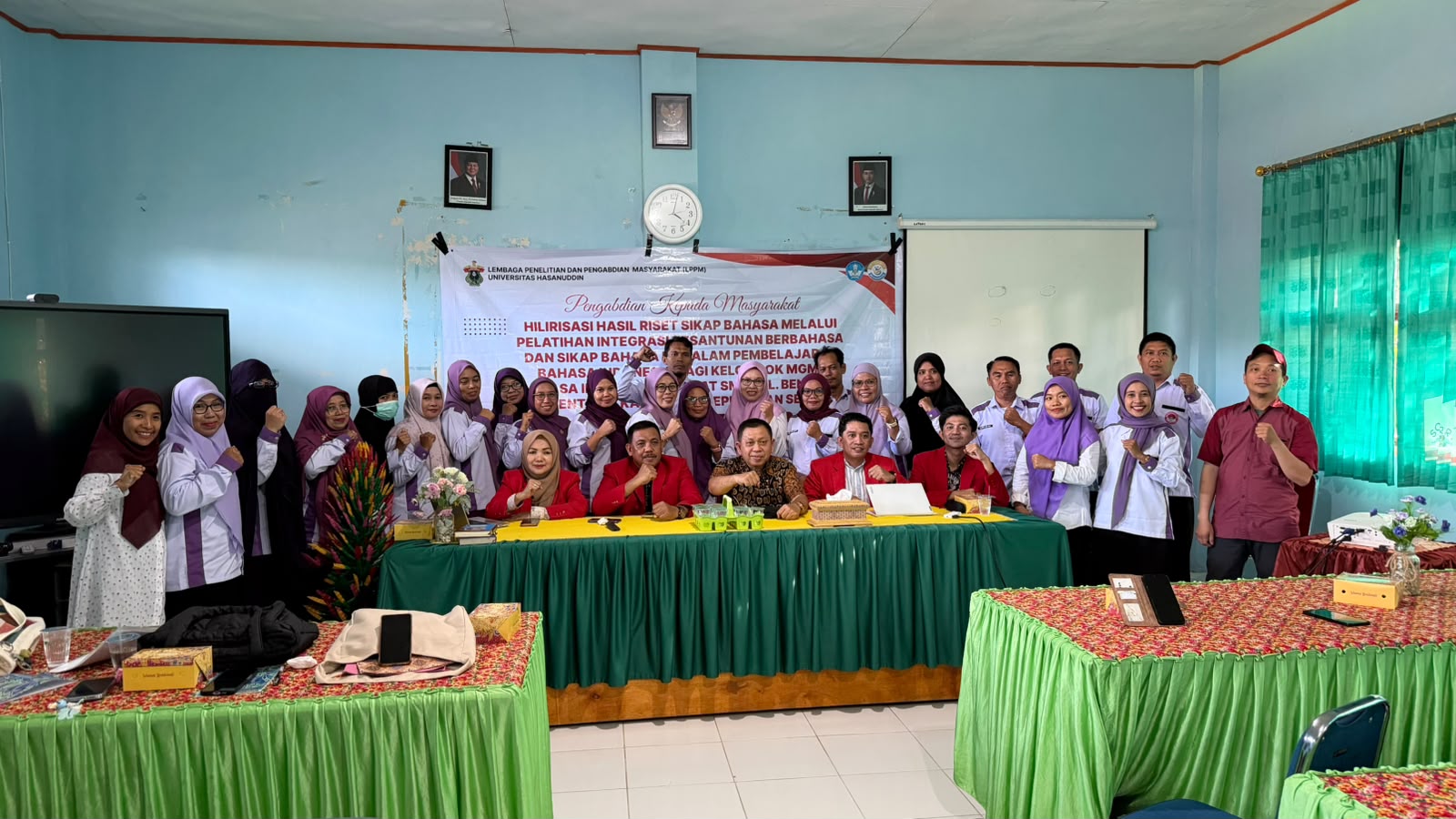
SELAYAR — Hasanuddin University, through its University Community Service–Community Partnership Program (PPMU-PK-M) 2026, organized a community engagement program titled "Training on Integrating Language Politeness and Language Attitudes into Indonesian Language Learning for the Junior High School Indonesian Language Teachers' Working Group (MGMP) of the Selayar Islands Regency." The program was held in Benteng, Selayar Islands Regency, on 12–13 June 2026.
The community service program was led by Prof. Dr. Munira Hasjim, S.S., M.Hum., with team members Prof. Dr. Kaharuddin, M.Hum., Prof. Drs. Burhanuddin Arafah, M.Hum., Ph.D., and Dr. Nursidah, S.Pd., M.Pd.
Project leader Prof. Munira Hasjim explained that the program represents the downstream implementation of university research into the professional practice of Indonesian language teachers.
The primary beneficiaries of the program were junior high school Indonesian language teachers who are members of the Indonesian Language Teachers' Working Group (MGMP) in the Selayar Islands Regency, while junior high school students throughout the regency were expected to benefit indirectly.
"Indonesian language teaching has traditionally focused on language skills and achieving curriculum targets. Meanwhile, the development of positive language attitudes and language politeness has not yet been systematically integrated into classroom instruction. This training was designed to address that need," said
Prof. Munira, who also serves as Head of the Hasanuddin University Central Library.
The MGMP for Junior High School Indonesian Language Teachers in the Selayar Islands Regency is based in Benteng Subdistrict, approximately 150 kilometers from Hasanuddin University. As the program's partner, the MGMP contributed by identifying training needs, organizing participants, providing facilities, and ensuring follow-up activities through its professional teachers' forum.
Through the training, the community service team introduced a range of research-based pedagogical resources that had previously been unavailable, including training modules, practical teaching guidelines, and sample lesson modules that teachers can collaboratively develop and implement within the MGMP network.
The program consisted of conceptual sessions on language attitudes and language politeness, workshops on integrating these values into lesson modules and classroom activities, simulations of lesson implementation, and mentoring sessions for developing teaching materials. Participants also received MGMP support materials that can serve as collaborative teaching resources and references for improving Indonesian language instruction in schools.
Prof. Munira expressed her hope that the program would strengthen teachers' capacity to foster a culture of polite and positive language use within educational settings.
According to her, Indonesian language education should not merely focus on developing students' linguistic competence but should also function as a medium for character building through the use of appropriate, respectful, and ethical language.
"Through this program, we hope teachers will be able to continuously integrate the values of language politeness and positive language attitudes into their teaching practices, thereby contributing to the development of students' character throughout the Selayar Islands Regency," said the Professor of Indonesian Literature at Hasanuddin University. (*)