
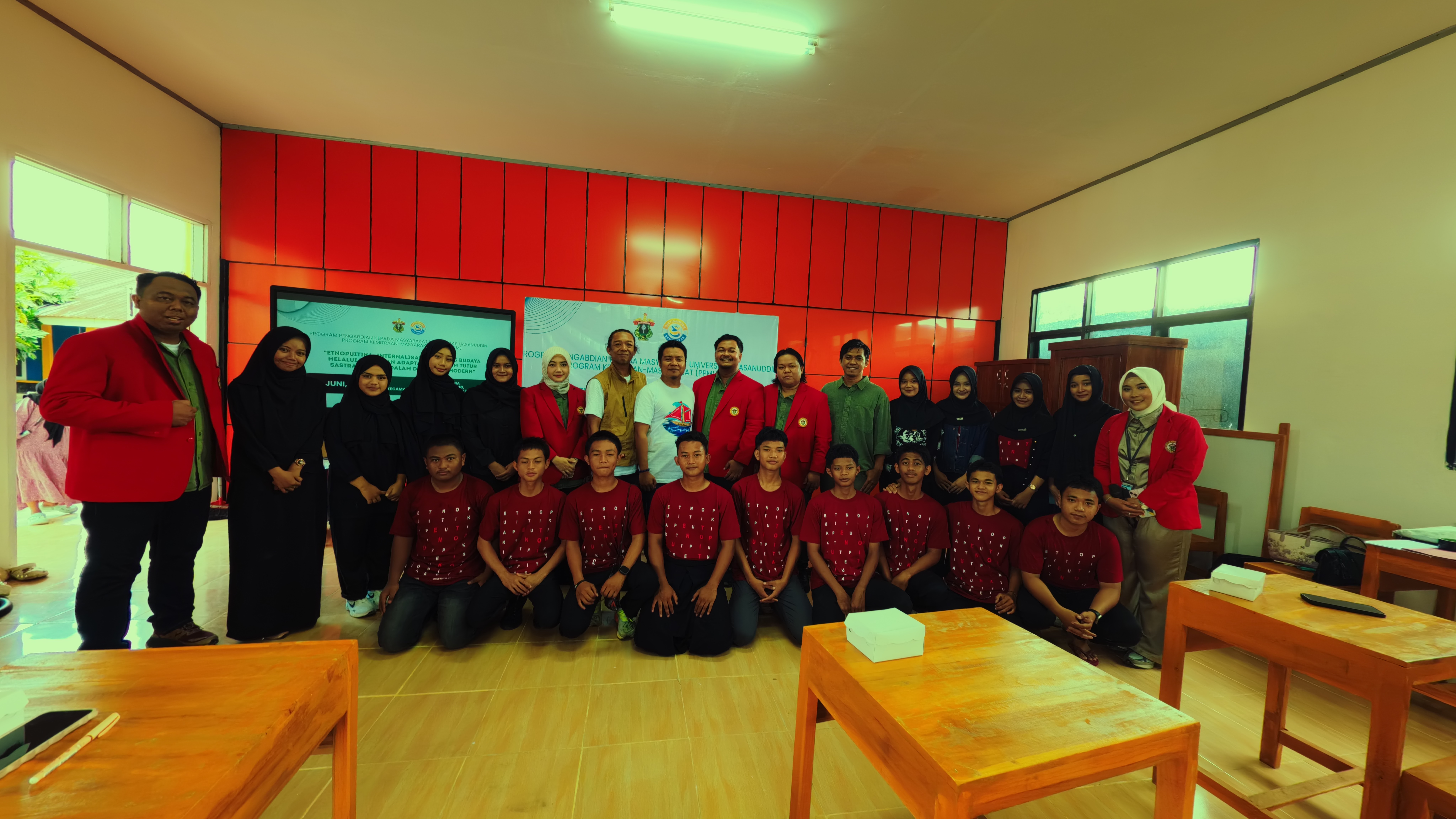
Reviving Oral Tradition Through Poetry: SMAN 9 Bulukumba Students Trained to Adapt Local Oral Styles into Modern Poetry Recitation
BULUKUMBA — A community service team from Hasanuddin University, through the University Community Partnership Program (PPMU-PKM), organized a program titled "Ethnopoetics: Internalizing Cultural Identity through Training on Adapting Oral Literary Styles into Modern Poetry Recitation" for students of SMAN 9 Bulukumba. The activity was held on 12–13 June 2026 at SMAN 9 Bulukumba in Dannuang Village, Ujung Loe District, Bulukumba Regency.
A total of 20 students participated in the training. The community service team was led by Faisal Oddang, with members Syahwan Alfianto Amir, Khairil Anwar, Andi Meirling, Dian Rahmawati Arif, and Ilham. The program also involved two university students, Alifia Nur Dalsyinta and Zalza Nur Fadillah HS. Representing the school were Indonesian language teacher Andi Iswan Pangki and Vice Principal for Curriculum Abd. Qadri.
The event began with a traditional Paduppa welcoming dance performed by students who are members of the school's arts organization, Asera, setting a warm and culturally rich atmosphere for the program.
In his opening remarks, Vice Principal Abd. Qadri expressed his appreciation for Hasanuddin University's trust in selecting SMAN 9 Bulukumba as a partner for the program. He thanked the lecturers from the Faculty of Cultural Sciences for choosing the school as the venue for the community engagement activity.
According to him, programs like this play an important role in strengthening students' literacy skills while fostering appreciation for local culture. He hoped the entire series of activities would run successfully and achieve its intended objectives.
Rediscovering the Richness of Oral Literature
The program aims to reintroduce the richness of South Sulawesi's oral literary traditions to younger generations through a creative approach that connects traditional storytelling techniques with modern poetry performance. Participants were encouraged to explore various oral narrative styles as both sources of inspiration and aesthetic strategies for poetry recitation.
Team leader Faisal Oddang explained that South Sulawesi is home to diverse oral traditions, each with distinctive storytelling techniques.
"In the context of poetry performance, this diversity can serve as both an approach and an aesthetic strategy," he said.
During his lecture, Faisal—an Indonesian Literature lecturer at Hasanuddin University's Faculty of Cultural Sciences and an acclaimed writer—shared insights from his poetry collections Manurung: 13 Pertanyaan untuk 3 Nama (Manurung: 13 Questions for 3 Names) and Perkabungan untuk Cinta (Mourning for Love).
He also recounted his research on the La Galigo manuscripts conducted in the Netherlands in 2016, which later became one of the creative foundations for writing Manurung, published in 2017.
According to Faisal, poetry is inherently present in everyday life, yet people often fail to recognize or name the poetic experiences surrounding them. Therefore, understanding poetry requires more than reading written texts—it also demands engagement with the cultural experiences and living traditions of society.
The next session was delivered by Syahwan Alfianto Amir, who emphasized that poetry recitation is the art of presenting literary works in an aesthetic, meaningful, and emotionally expressive manner.
Unlike ordinary reading, poetry performance requires readers to interpret the meaning embedded in the text and convey it through voice, facial expressions, and body language.
He explained that poetry is a form of language that carefully considers sound patterns while also relying on nonverbal expression to reveal the multiple layers of meaning arising from a poet's imaginative, emotional, and intellectual experiences.
Such experiences may originate from deeply personal moments or broader social realities. Although poetry continues to evolve alongside advances in knowledge, technology, and artistic experimentation, it retains distinctive characteristics that set it apart from other forms of expression.
Syahwan stressed that an effective poetry performer does more than simply read words aloud. A skilled performer brings the poem to life, enabling the audience to experience its emotions, imagery, atmosphere, and underlying message.
For this reason, poetry recitation serves not only to communicate meaning effectively and showcase the beauty of language and sound, but also to honor the poet's work through thoughtful interpretation while contributing to the preservation of oral literary traditions.
During the practical session, participants learned a variety of poetry performance techniques, including vocal articulation exercises for clearer pronunciation, understanding the poem's meaning before performing, marking pauses and intonation within the text, practicing facial expressions in front of a mirror, and mastering breathing techniques to maintain vocal stability throughout the recitation. (*)