
Unhas Incubates Garanta Village Youth, Instilling Walenrenge Maritime Character Values in the Younger Generation
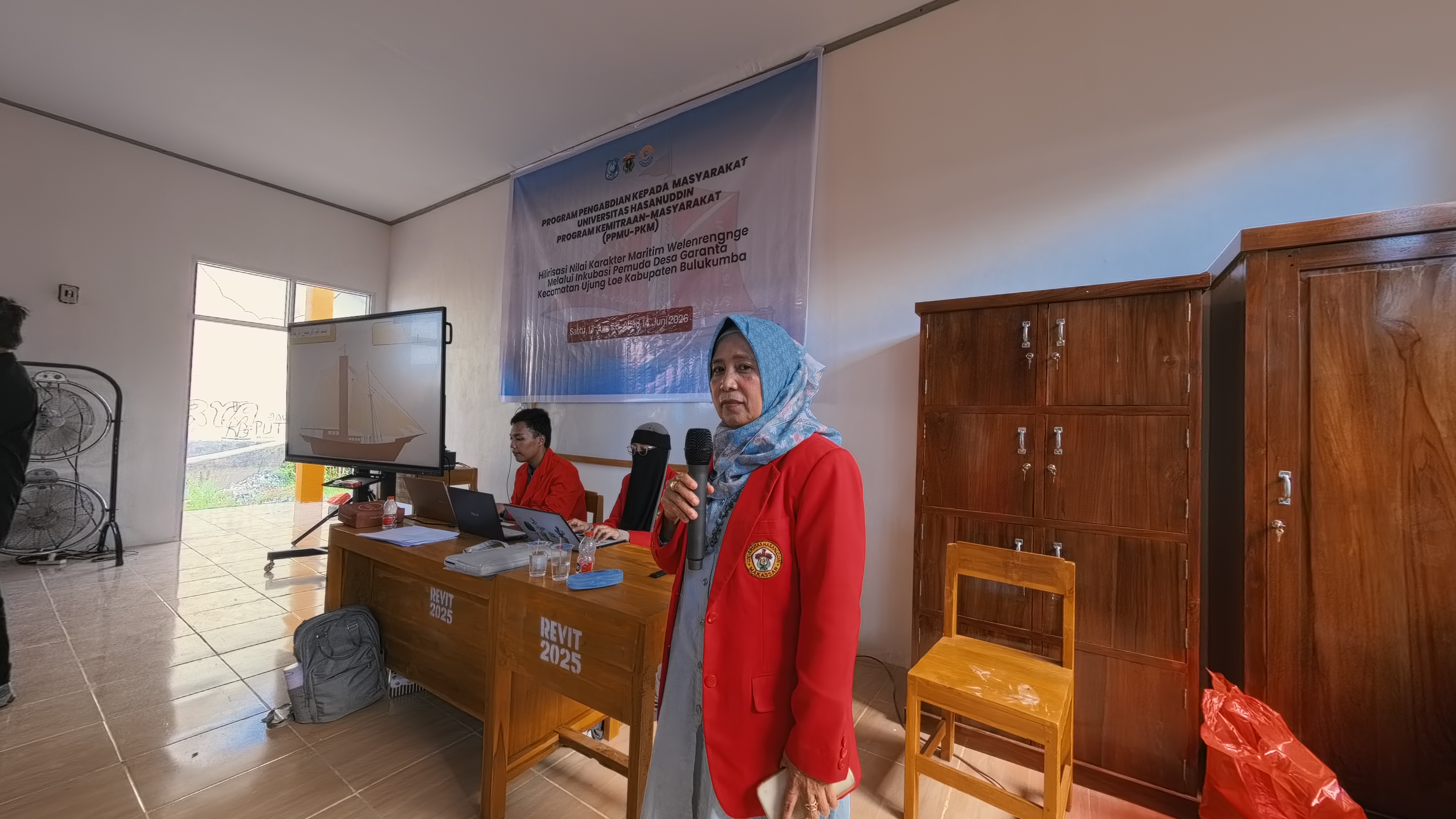
BULUKUMBA — The Community Service Team of Hasanuddin University (Unhas), through the 2026 Community Partnership Program (PPMU-PK-M), conducted a community engagement program entitled "Disseminating Walenrenge Maritime Character Values through Youth Incubation in Garanta Village, Ujung Loe District, Bulukumba Regency" in Garanta Village on June 13–14, 2026.
The program was officially opened by Hasanuddin, Secretary of Garanta Village, representing the Village Head, Muhammad Subair. The initiative aimed to strengthen the character of young people by internalizing the Walenrenge maritime character values, which are rooted in the local wisdom of the Bugis-Makassar community.
Youth participants from Garanta Village took part in a series of activities focusing on character development, leadership, and a deeper understanding of the Walenrenge philosophy as a framework for personal growth. Through the program, participants were encouraged to embody local cultural values as the foundation for building resilient, adaptive, and competitive character in the face of contemporary challenges.
The community service team was led by Dr. St. Nursa’adah, M.Hum., with members Prof. A.B. Takko Bandung, M.Hum., Mutahharah Nemin Kaharuddin, S.S., M.Hum., and student assistants Itrha Febrianta, Ilma Ratmiyanti, Syahrul Ramadhan, Azizah Az Zahrah, and Ismail Basri.
In the first session, Dr. St. Nursa’adah delivered a presentation on character development. She emphasized that every individual possesses the potential to achieve success, and that such potential is not always measured in material wealth. According to her, determination is the most essential asset anyone can have.
“Where there is determination, there is a way. The willingness to attend and learn is the first step toward achieving one's aspirations. Success is determined not only by intelligence, talent, or wealth, but also by the ability to make decisions, communicate effectively, and face challenges,” she said.
She also highlighted the importance of one's environment in shaping character. Family, schools, and the community all play significant roles in instilling positive values that influence the future of young generations.
In the second session, Prof. A.B. Takko Bandung introduced the Walenrenge Model as a character-building framework rooted in local cultural values. He explained that the philosophy of Walenrenge draws inspiration from the La Galigo epic, particularly the journey of Sawerigading in search of We Cudai.
According to him, every person possesses The Alena, or a self-model, which is shaped by what one sees, reads, and the people with whom one interacts. Therefore, self-awareness is a crucial first step in developing strong character.
“Know yourself. In Bugis wisdom there is a saying, Ajeppui alemu, muajeppui Puang-Mu, which means that when a person truly knows themselves, they also come to know their Creator more deeply,” he explained.
He further stated that human beings are created as complete beings, endowed with both physical abilities and intellect. However, true greatness is measured not by wealth or capability alone, but by one's ability to manage life wisely while maintaining a strong relationship with God.
During the session, Prof. Takko also elaborated on the concept of MARITIM, an acronym representing the maritime character values of Mandiri (Independent), Manusiawi (Humane), Arif (Wise), Religius (Religious), Inovatif (Innovative), Tangguh (Resilient), and Berintegritas (Integrity). These values are expected to serve as the foundation for young people in navigating life's challenges.
The program concluded with an interactive discussion and question-and-answer session. One participant, Musdalifa, asked how someone could use another person as a source of motivation without constantly comparing themselves to that individual, and how to maintain enthusiasm when their efforts have yet to produce the expected results.
Responding to the question, Prof. Takko, a Professor of Indonesian Literature at Hasanuddin University, explained that people can draw inspiration from others without engaging in unhealthy comparisons. He emphasized that every individual has a unique life journey, different abilities, and their own timeline for achieving success. He also reminded participants that setbacks and unmet expectations are natural parts of the learning process and essential steps toward personal growth and eventual success.