UNHAS ADMINISTRATIVE SCIENCE STUDENTS VISIT MAKASSAR’S BRIDA TO DISCUSS QUANTITATIVE RESEARCH AND PUBLIC POLICY
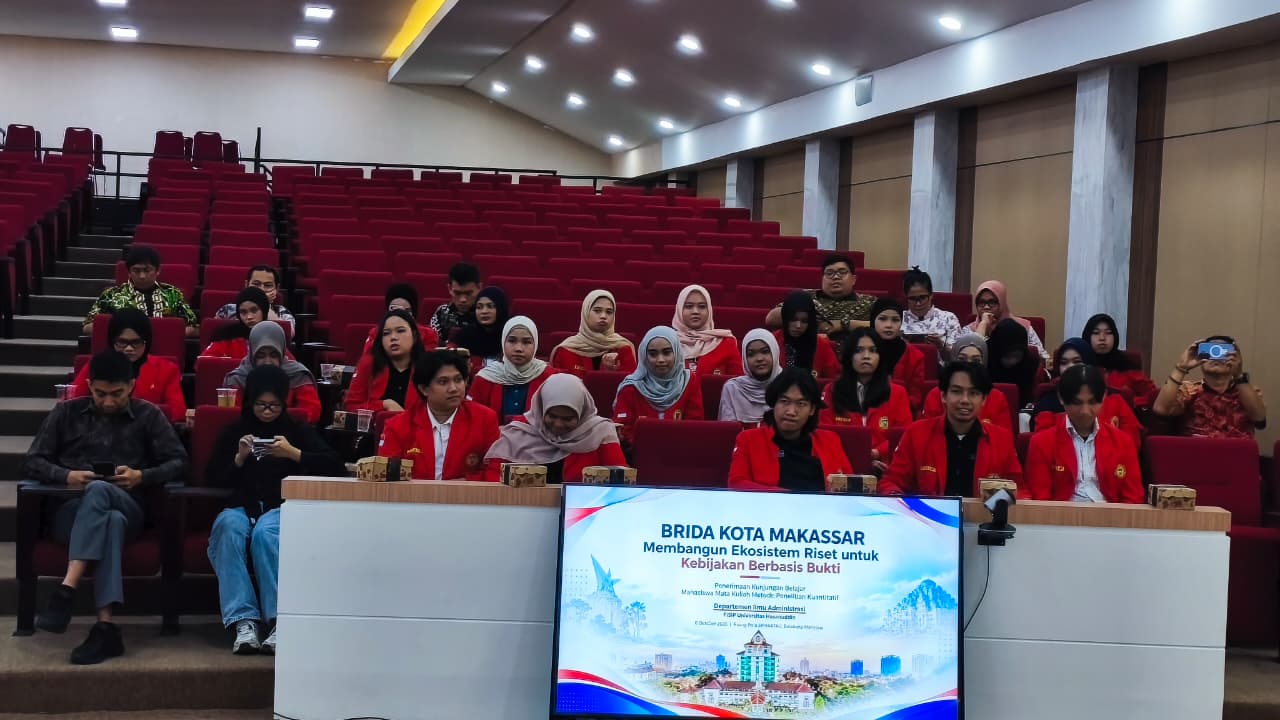
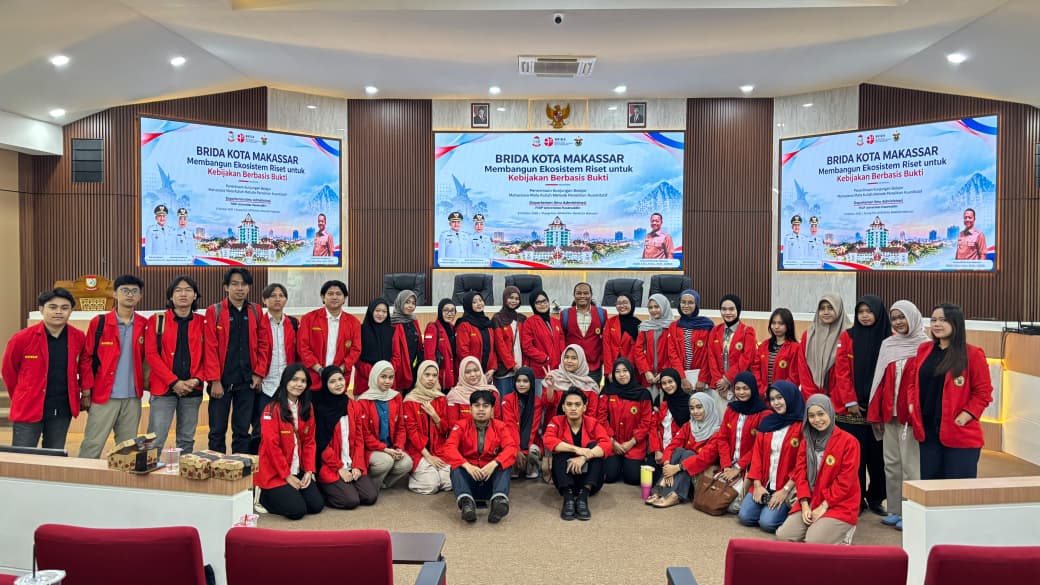
Makassar, 8 October 2026 — The Department of Administrative Science, Faculty of Social and Political Sciences (FISIP), Hasanuddin University, conducted a study visit to Makassar’s Regional Research and Innovation Agency (BRIDA) on Thursday, 8 October 2026, from 1:00 to 4:00 p.m. Central Indonesia Time (WITA). The visit formed part of the Quantitative Research Methods course and involved students and accompanying lecturers.
The delegation was welcomed directly by the Head of Makassar BRIDA, Haidil Adha, S.Sos., M.M., CHRM., accompanied by BRIDA Secretary Dr. Alamsyah Sahabuddin (cand.), Innovation Team Leader Dr. Muhammad Amri Akbar, S.P., M.Si., Research Working Team Leader Dody Agriyanto, and expert staff and other personnel. The discussion took place in a warm and interactive atmosphere.
In his presentation, the Head of BRIDA explained that Makassar BRIDA evolved from the Regional Research and Development Agency (Balitbangda). The relevant regional regulation (Perda) was enacted in 2023, followed by a mayoral regulation (Perwali) in 2024. BRIDA officially became a standalone agency in 2024, with Haidil Adha serving as its first head. In September 2025, Makassar BRIDA received the 2025 Appreciation Award for Optimal BRIDA/BAPPERIDA Performance from the National Research and Innovation Agency (BRIN), in the category “BRIDA’s Role in Optimizing Regional Potential and Addressing Regional Problems.”
BRIDA’s mandate encompasses research, development, assessment, application, and innovation, all directed toward evidence-based regional development. The Head of BRIDA emphasized that the agency serves as a hub for research, rather than conducting all research itself. Each year, BRIDA establishes themes for collaborative research. For 2026, it has identified 40 themes covering strategic issues such as employment, energy, food, education, and the creative economy.
Regarding the integration of research and policy, BRIDA’s research findings are translated into policy recommendations for the Mayor, guided by priorities derived from the Regional Medium-Term Development Plan (RPJMD). BRIDA uses National Integrated Social Data, which have been incorporated into the One Data (Satu Data) system, and also collects primary data, using macro-level data from Statistics Indonesia (BPS) as a foundation. Its recommendations specify findings, necessary actions, the parties to be involved, locations, and scope. Implementation is carried out by regional government agencies (OPD), which access funding according to their needs.
During the discussion, students raised six critical questions. The first concerned how BRIDA ensures that its research delivers practical benefits. The second addressed data consistency across regions before the data are used as a basis for policy. The third examined sampling strategies in collaborative research, considering Makassar’s diverse characteristics, including densely populated Tamalanrea and island areas that are difficult to reach. The fourth concerned the evaluation of development impacts to avoid premature conclusions. The fifth addressed research independence and methodological audits. The sixth examined BRIDA’s internal technocratic capacity to translate BPS data into policy recommendations.
In response, BRIDA explained that all its research is ongoing and measurable, citing the urban farming program as an example. Research independence is maintained through integrity, data triangulation, and evaluations by the inspectorate whenever discrepancies are identified. BRIDA reaffirmed its commitment to building a research hub grounded in integrity and preparing sound policy recommendations for the Mayor to improve the welfare of the city’s residents. The agency also equips researchers with training, certification, and supporting software applications.
BRIDA offers opportunities for student collaboration through study visits, discussions, problem identification, collaborative research, internships, and the development of innovative outputs. Students can conduct research alongside BRIDA’s research team on proposed themes, with the findings published in scholarly journals. Previous research has included studies in Sangkarrang and Mariso districts, technologies for converting seawater into freshwater, solar cells, sea-based Pete-Pete public transport, and boat ambulances. Research findings can be accessed through SIGAP BRIDA.
Ishak Salim, an accompanying lecturer, expressed his gratitude for the BRIDA team’s warm welcome and hoped that the visit would mark the beginning of a sustained partnership, including internship programs and collaborative research. The activity concluded with the presentation of a commemorative gift and a group photograph.